The 2026 China Open women's event lists $9,415,725 as its total prize-money commitment. The women's singles champion is due $1,151,380 and 1,000 WTA ranking points; the WTA's doubles champion row lists $468,200 and 1,000 points. These are official 2026 figures published before the Beijing main draw begins on September 30, so they describe the rewards at stake, not money already won.
The 2026 Beijing prize-money answer
Event commitment
$9,415,725
WTA women's event figure
Singles champion
$1,151,380
Plus 1,000 ranking points
Doubles champion row
$468,200
Plus 1,000 ranking points
Those headline numbers come from the WTA's September 24 Beijing guide and its official event overview. The tournament is a WTA 1000 on outdoor hard courts at the China National Tennis Center. Main-draw play is scheduled for September 30 through October 11. The singles draw contains 96 players, while the doubles draw contains 32 teams.
The figures below are organized by the round in which a player or team finishes. Read the first-round row as the listed reward for a first-round exit, the finalist row as the runner-up amount, and the champion row as the title-winning amount. They are not cumulative installments to add together for one player. A champion receives the champion amount listed in the applicable draw, subject to the competition's governing rules.
This article covers the women's WTA competition. Beijing also hosts men's tennis, but an ATP prize table is a separate document and may use different values. The WTA table should be the starting point whenever the search is about the women's China Open. As of September 26, the official 2026 score page still says scores are unavailable; no 2026 player has yet been confirmed as the winner.
Women's singles prize money and points by round
The official WTA Beijing 2026 guide publishes eight finish levels for women's singles. Each line below is the amount and points associated with ending the event at that stage. The first round of a 96-player tournament is sometimes called the round of 96, while the fourth round is the last 16.
Official singles payout table
| Finish | Prize money (USD) | WTA points |
|---|---|---|
| First round | $24,335 | 10 |
| Second round | $36,110 | 35 |
| Third round | $61,865 | 65 |
| Fourth round | $105,720 | 120 |
| Quarterfinal | $193,645 | 215 |
| Semifinal | $340,190 | 390 |
| Finalist | $612,340 | 650 |
| Champion | $1,151,380 | 1,000 |
For a straightforward example, a semifinalist's listed 2026 award is $340,190 and 390 points. Reaching the final lifts the finish-level amount to $612,340 and 650 points; winning the final lifts it to $1,151,380 and 1,000 points. Do not add the semifinal, finalist and champion rows together. The table reports the final stage achieved, which is why a single run appears in one row.
The largest money jump is from finalist to champion: $539,040. The points gap across the same step is 350. These differences help explain the value of the championship match, but they are tournament awards rather than a promise that an athlete's published world ranking will rise by the same number. Ranking calculation is covered below.
What a first-round bye changes
Beijing's 96-player singles draw gives the 32 seeds a first-round bye, according to the WTA. A bye means the seeded player is placed directly in round two without contesting an opening match. It does not mean she has won a first-round match against an opponent. Unseeded players ordinarily enter in round one, and qualifying can also determine places in the main draw.
When following a seeded player, look for her opening opponent and the official draw status rather than assuming she has already earned a win. Special cases such as a withdrawal, walkover or retirement may affect official accounting and are governed by tournament rules. The ordinary table still tells readers the scheduled 2026 rewards for each finish level; it should not be stretched into a ruling on every exceptional match scenario.
Women's doubles prize money and points by round
The women's doubles event has its own prize and points ladder. The 2026 China Open lists 32 teams in the doubles draw, so there are five finish levels from an opening-round exit to the title. The official WTA guide gives the following figures in US dollars; they should not be substituted for the singles values above.
Official doubles payout table
| Finish | WTA-listed prize money (USD) | WTA points |
|---|---|---|
| First round | $19,510 | 10 |
| Second round | $35,700 | 120 |
| Quarterfinal | $66,570 | 215 |
| Semifinal | $133,110 | 390 |
| Finalist | $247,870 | 650 |
| Champion | $468,200 | 1,000 |
A doubles finalist is listed at $247,870 and 650 points, while the champion row is $468,200 and 1,000 points. The difference between those listed amounts is $220,330, and the points difference is 350. As in singles, the rows describe alternative finishing positions, so a team that wins the title does not add the runner-up and earlier amounts to the champion line.
Reading the doubles figures correctly
The WTA article presents the doubles numbers under a draw-level prize-money heading but does not spell out a per-player split in the text. For that reason, the table here deliberately calls them WTA-listed amounts. It would be misleading to say each member of a winning pair personally takes home $468,200, or to divide the line by two and declare an official take-home figure, without a document that states the accounting convention. Player contracts, tax and expenses are also outside this prize table.
The points column is a tennis ranking award and should be read separately from cash. A doubles player can also compete in singles, but the two ranking categories have different counting systems. The official WTA ranking explainer says doubles rankings use a player's best 12 results over a 52-week period. It follows that an awarded 1,000-point doubles title is meaningful, yet an individual's net ranking change depends on which earlier result it replaces in that calculation.
The 32-team size also explains why there are fewer named rounds than in singles. A pair needs to navigate an opening round, second round, quarterfinal, semifinal and final. The WTA schedule places the doubles final on Sunday, October 11, before the singles final. Until a bracket and match results are official, this table is the reliable answer to what each doubles finish is worth, not a statement about any particular 2026 pair.
What the $9,415,725 figure actually means
The WTA's 2026 event page uses the label Total $ Commitment for $9,415,725. Its tournament guide describes the same number as the prize money available in Beijing. These descriptions identify the scale of the women's event, while the per-round tables show the listed awards for particular finishes. An individual player's check is determined by her event and finish, not by dividing the commitment equally among entrants.
Total commitment versus a champion's check
The $9,415,725 headline is much larger than the singles champion's $1,151,380 because it refers to the tournament-wide figure. It cannot be read as the winner's personal award or as a payout for every player. The doubles champion row is $468,200, but that also belongs to a separate event table. A player reaching different rounds in singles and doubles would need each applicable official result and the governing prize rules to calculate her own event earnings.
The word commitment is also useful when comparing tournaments. Event overviews may use the figure as a standardized headline, while specific guides provide a more detailed breakdown. Readers should compare the same kind of WTA event figure across years, and should keep ATP and WTA amounts apart. An ATP chart appearing beside the Beijing event online does not replace the women's table shown here.
How 2026 compares with 2025
The official 2025 China Open overview listed $8,963,700. The 2026 figure is $452,025 higher, an increase of approximately 5.04% calculated against the 2025 number. The women's singles champion line rose from $1,124,380 in the 2025 WTA prize guide to $1,151,380 in 2026, a $27,000 difference. Both guides give the champion 1,000 ranking points, so the cash line grew while the title's advertised point value stayed at the WTA 1000 level.
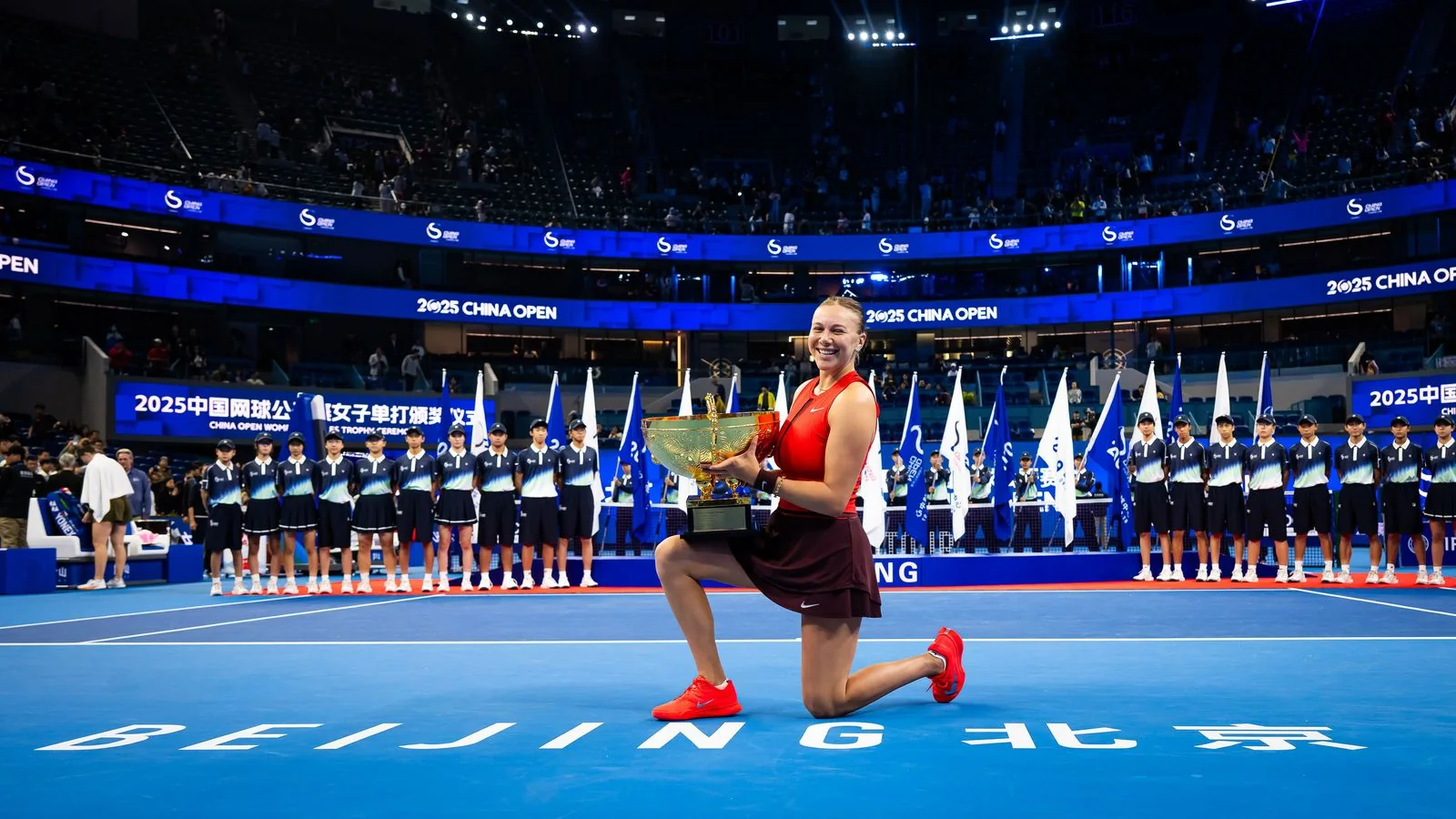
Year-to-year figures tell us about the published award structure, not who will collect it. Amanda Anisimova won the 2025 singles title, but the WTA reported her 2026 withdrawal on September 25. A 2025 champion photo or result therefore cannot be used as evidence about the 2026 winner. The 2026 money remains on offer as the tournament approaches; actual player earnings follow the official results.
How Beijing points affect a WTA ranking
The points column answers what the China Open awards for a finish; it does not predict the number beside a player on the next published ranking list. The WTA's ranking explanation describes a rolling 52-week system. Results from earlier tournaments can leave the calculation as new results enter, and only a specified selection of events counts toward each ranking total. Cash rewards and points also answer separate questions: a larger check never automatically produces a larger ranking rise.
Points earned versus points gained
Suppose a player wins Beijing in 2026. The event awards 1,000 singles points. If a prior result worth 650 points leaves her counting total at the relevant update, the simple difference between those two results is 350 points. That is an illustration of replacement, not an actual forecast for any player. If a different prior result is replaced, another current result becomes countable, or a rule about mandatory events applies, the net change can differ.
The WTA's 2026 Beijing guide directly warns that a change in rank depends on a player's performance compared with points earned in the corresponding period last year. A player who matches a strong previous Beijing result may earn a substantial new tournament award without gaining the same number of net points. Conversely, a deeper run than last year's can improve her position relative to that previous result. The ranking position itself also depends on other players' results, so a point increase does not promise a particular world rank.
Beijing's place in the ranking calculation
Beijing is a combined WTA 1000 in the WTA's ranking explainer. For top-ranked singles players, the displayed formula identifies four Grand Slams, the best six combined WTA 1000 results, the best one non-combined WTA 1000 result, and seven further eligible results. The explainer lists Beijing in the combined group alongside Indian Wells, Miami, Madrid, Rome, Toronto or Montreal, and Cincinnati. Wuhan is in the non-combined WTA 1000 group. This grouping is why it is useful to know an event's level and draw, not merely that its champion gets 1,000 points.
The same official page says singles rankings use a maximum of 18 tournament results, with WTA Finals points potentially counting as an additional 19th event. Doubles uses a player's best 12 results over 52 weeks. These are broad rules; the linked 2026 WTA rulebook governs detailed cases. Anyone making a player-specific ranking projection should check that player's existing counting results and the applicable rulebook, rather than subtracting the old Beijing score from the new Beijing score in isolation.
With Beijing scheduled late in the season, its results can also matter to the race toward the year-end Finals. Yet the 1,000-point ceiling says only what the tournament can award to its winner. It does not tell us who is already qualified or how many points a particular player needs. The WTA rankings page is the appropriate place to see the latest published standings, while the official tournament table remains the source for Beijing's award levels.
When the money and points are decided
The prize tables are official ahead of the 2026 main draw, but a player's finishing row becomes clear only when her tournament run is resolved. As of September 26, the WTA's 2026 Beijing score page explicitly says scores are not available yet. It would be premature to label any athlete a 2026 quarterfinalist, finalist or champion, even if an entry list or preview mentions her name.
The 96-player draw and the tournament dates
Women's singles main-draw play is scheduled from Wednesday, September 30 through Sunday, October 11. The WTA places the first round on September 30–October 1, the second round on October 2–3, the third round on October 4–5 and the fourth round on October 6–7. Quarterfinals follow on October 8–9, semifinals on October 10 and the singles final on October 11, not before 7 p.m. Beijing local time. The first doubles round is scheduled for October 4–5, with the doubles final set for October 11 at 4:30 p.m. local time.
Those dates put a reader's money question in context. A player reaching the October 8–9 singles quarterfinal stage would be tracking toward the $193,645 and 215-point row; only an official loss or later progress settles her final finishing row. For real-time order and eventual scores, the WTA calendar helps locate the tournament, while the WTA event's live draw and score pages should control individual results.
Withdrawals, walkovers and rule details
Beijing's 96-player field and seeded byes make the printed bracket more complex than a simple sequence of eight matches per athlete. A player's entry can change before play. On September 25, for example, the WTA reported withdrawals for Jessica Pegula, 2025 champion Amanda Anisimova, Marta Kostyuk and Sorana Cirstea. Any earlier projected field that still lists them as active is stale for that purpose.
Once matches begin, retirements, walkovers and replacement entries can affect how a player appears in the draw. The normal finish-level table remains the correct published baseline, but a general article cannot adjudicate every exceptional prize or point case from a headline alone. The 2026 WTA Official Rules and the tournament's recorded results are the relevant authorities. If a player-specific amount matters, verify her final official status first and then apply the rulebook rather than treating a walkover as an ordinary completed win.
The timing also matters for searches such as “China Open prize money today.” Before September 30, the answer is the announced reward schedule. During the event, that schedule is still useful, but a particular player's entitlement is provisional while she remains in the draw. After the final, the champion and runner-up rows can be attached to named competitors using the official 2026 results.
China Open prize-money questions
The short answers below use the WTA's announced 2026 Beijing figures, checked on September 26. They apply to the women's tournament and distinguish an advertised finish-level award from a completed result or a net change in someone's published world ranking.
How much does the 2026 women's champion receive?
The women's singles champion is listed for $1,151,380 and 1,000 ranking points. The runner-up line is $612,340 and 650 points. In the separate women's doubles table, the WTA lists $468,200 and 1,000 points for the champion row. The WTA article does not explain a per-player split for its doubles cash figure, so quote the row as published rather than assigning the full amount to each partner. Since the event begins after this article's September 26 research date, these figures describe what is at stake, not a prize already collected by a named 2026 champion.
Does the China Open pay ATP and WTA players from the same table?
No single table should be assumed to cover both competitions. The amounts on this page are taken from the WTA's women's event guide and the WTA China Open overview. Searches for “China Open prize money” can surface ATP coverage as well because men's and women's professional tennis both use the Beijing event name. When comparing a player payout, first identify whether the source is a WTA women's singles table, a WTA women's doubles table or a separate ATP tournament source. The $9,415,725 figure here is the WTA event's published total commitment.
Does winning 1,000 points guarantee a 1,000-point ranking increase?
No. A Beijing singles title is worth 1,000 tournament points. The WTA ranking is a rolling 52-week calculation based on counted results, so points leaving the calculation and other counting rules affect the net total. The title can be very valuable even when the player's published ranking total rises by less than 1,000. Her ordinal position also depends on what competitors do during the same update period. Use the official WTA ranking explanation for the formula and the current rankings for observed standings after play, rather than treating the tournament's points table as a guaranteed movement chart.