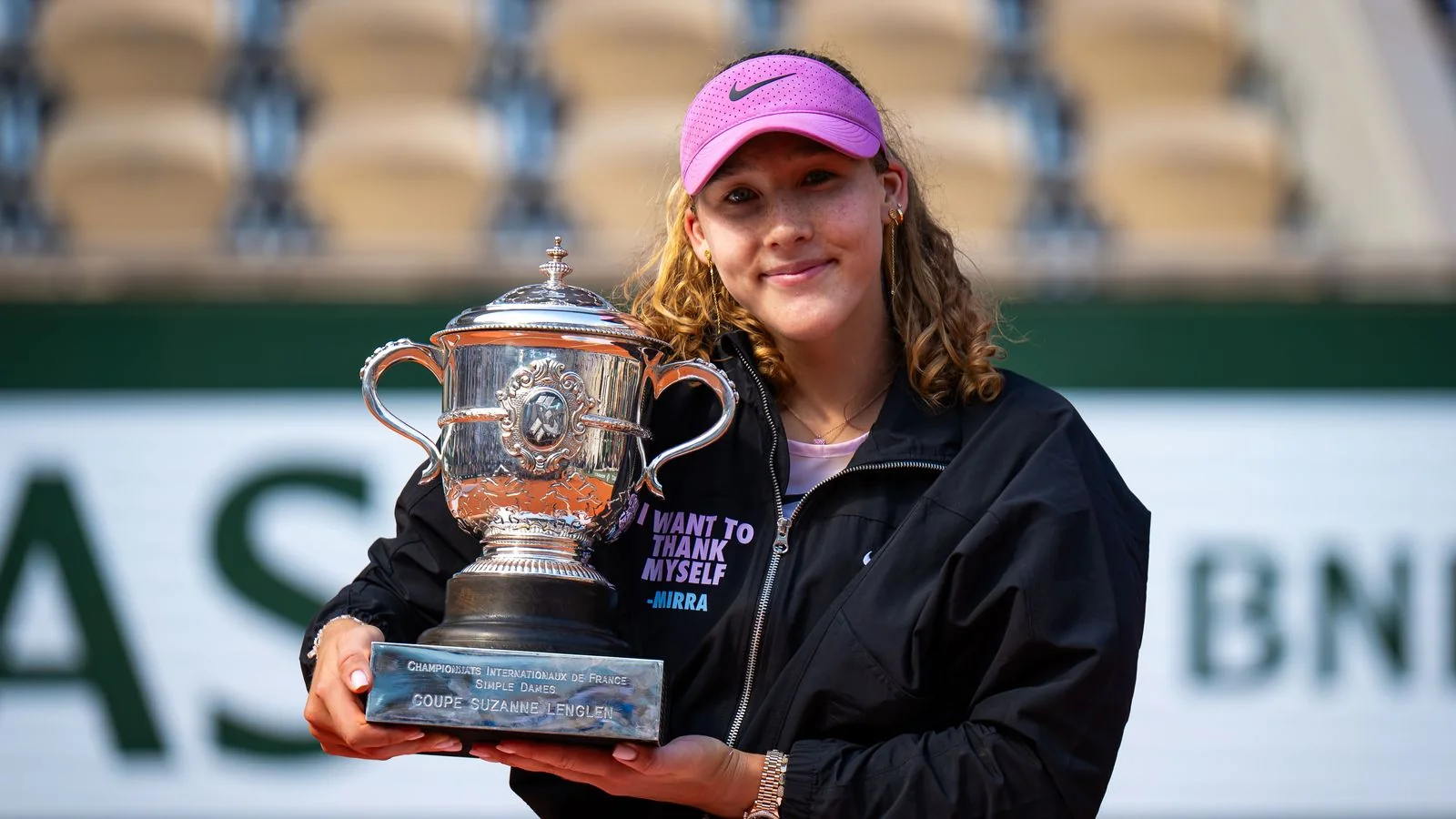
Mirra Andreeva won the 2026 Roland Garros women's singles title, defeating qualifier Maja Chwalinska 6-3, 6-2 on June 6. Katerina Siniakova and Taylor Townsend won the women's doubles final the following day, beating Anna Danilina and Aleksandra Krunic 6-2, 7-5. These are completed French Open results, reviewed here through the matches and achievements behind the trophies.
Andreeva's first major supplies the headline. The fuller story includes her commanding second week, Chwalinska's nine wins from qualifying to the final and the doubles champions' recovery in their last set. Looking at those paths together explains what distinguished the women's competitions in Paris, beyond the final scores.
The completed women's finals in Paris
Mirra Andreeva was the women's singles champion and Katerina Siniakova and Taylor Townsend were the women's doubles champions at Roland Garros in 2026. The main-draw tournament ran from May 24 to June 7 on the outdoor clay courts of Stade Roland Garros. The singles championship was decided on Saturday; the doubles trophy followed on Sunday.
| Competition and final date | Champions | Runners-up | Final score |
|---|---|---|---|
| Women's singles, June 6 | Mirra Andreeva | Maja Chwalinska | 6-3, 6-2 |
| Women's doubles, June 7 | Katerina Siniakova / Taylor Townsend | Anna Danilina / Aleksandra Krunic | 6-2, 7-5 |
The two finals produced different kinds of breakthrough. Andreeva became a Grand Slam singles champion for the first time. Siniakova and Townsend won their first Roland Garros title together, adding a Paris title to an already successful partnership. That distinction matters: a team's first trophy at a tournament does not mean that neither player had previously won there with someone else.
These were separate draws, with 128 singles players and 64 doubles teams. The singles final tells only part of the women's tournament story. The doubles result also deserves to be read in its own competitive setting, particularly because the top two seeded pairs met for the championship. Both finals ended in straight sets, but neither score alone explains the passages when the eventual winners had to establish control.
How Andreeva took control of the singles final
Andreeva's 6-3, 6-2 victory on Court Philippe-Chatrier took 82 minutes. The eventual margin suggests a clear separation, yet the early scoreboard gave neither player that comfort. The match became one-sided through a sustained change in who could protect a lead, rather than through an immediate sprint away from the first game.
The early breaks gave way to a decisive run
The first four games were breaks of serve. Chwalinska then held for 3-2, before Andreeva held to level and began the run that decided the match. From that point the teenager won nine consecutive games: the last four of the opening set and the first five of the second. A final that had been level in practical terms became a set and a large deficit for the qualifier to recover.
That sequence is more informative than simply calling the match comfortable. In an exchange of early breaks, winning a return game does not guarantee a lasting advantage. The break has to survive the next service game. Andreeva was the player who began putting those pieces together repeatedly. Once that happened, Chwalinska could no longer reset the contest through another immediate response.
Chwalinska did recover two games from 5-0 down in the second set. Andreeva then broke again to finish, rather than allowing the missed first chance to serve out the title to develop into a larger problem. The official final report describes difficult, breezy conditions. They formed part of the setting for both players; the recorded run and the closing response are firmer evidence of the difference between them than any guess about precisely what either player was feeling.
The numbers behind the straight-sets score
The WTA scorecard credits Andreeva with 62 of the match's 103 points, or 60.2 percent. She converted seven of 12 break points, while Chwalinska took three of eight. Both players created return opportunities, but the champion created more and converted a larger share. That combination explains why the early exchanges eventually stopped producing an even scoreboard.
Those figures also keep the interpretation proportionate. Chwalinska did not spend the entire match without a chance against the Andreeva serve. Equally, having chances is different from sustaining the pressure needed to turn them into a competitive second set. The champion's advantage stretched across the total points as well as the crucial return opportunities. The final was settled by a run of repeated success, followed by a controlled ending, rather than by a single isolated point that could explain everything.
The champion's second week set the standard
Andreeva lost only one set in the singles tournament, against Marina Bassols Ribera in the second round. She answered that opening-set loss by winning the next two sets 6-1, 6-1. The early recovery matters because the finished record was not a sequence of seven identical, trouble-free wins. She had to reset before building the consistency that defined her closing rounds.
From the fourth round onward, she conceded 17 games across four matches. That total comes directly from the scores below: five against Jil Teichmann, three against Sorana Cirstea, four against Marta Kostyuk and five in the final. None took her to a deciding set. Repeating that level through the latter half of a Grand Slam is a different achievement from producing one outstanding afternoon.
| Round | Opponent | Andreeva's winning score |
|---|---|---|
| Fourth round | Jil Teichmann | 6-3, 6-2 |
| Quarterfinal | Sorana Cirstea | 6-0, 6-3 |
| Semifinal | Marta Kostyuk | 6-1, 6-3 |
| Final | Maja Chwalinska | 6-3, 6-2 |
Cirstea and Kostyuk could not extend her
The quarterfinal against 18th seed Cirstea lasted 56 minutes. Andreeva won the opening set without conceding a game, then completed a 6-0, 6-3 victory. It was a played, completed match. Cirstea's plans to retire from the sport at the end of the season were part of her wider story, rather than a retirement during this quarterfinal.
Kostyuk offered a particularly useful test of the champion's progress. She arrived at the semifinal unbeaten in 17 clay-court matches that season and had defeated Andreeva in the Madrid final. Andreeva reversed that result in Paris, winning 6-1, 6-3. The earlier meeting gave a reason to take the challenge seriously; it did not dictate what the rematch had to become.
There is no need to enlarge the route by adding opponents Andreeva did not face. Her draw was her draw, and the strongest evidence is how she handled the players who reached her. The second-week scores show sustained control. They support an assessment of an excellent tournament, while leaving future form and hypothetical matches against eliminated seeds as separate questions.
Chwalinska made the longer journey to the final
The runner-up's achievement needs a starting point earlier than the first round. Maja Chwalinska arrived ranked No. 114 and came through qualifying before reaching her first Roland Garros main draw. At 24, she became the first qualifier to reach the women's singles final here in the Open Era. The final was the end of an extraordinary run, even though it did not end with the trophy.
Qualifying made this more than a six-match run
Chwalinska won three qualifying matches and six main-draw matches to reach the championship match. That made nine successive victories before facing Andreeva in her tenth match of the event. A standard main-draw results list shows the six wins that brought her to the final; the qualifying route explains why her stay in Paris was a longer undertaking than that list suggests.
Her main-draw opponents were Zheng Qinwen, Elise Mertens, Maria Sakkari, Diane Parry, Anna Kalinskaya and Diana Shnaider. The Sakkari match required a recovery from a lost opening set: Chwalinska won 1-6, 6-3, 6-2. Her last two wins also involved close first sets, with a 7-6(3), 6-3 quarterfinal victory over Kalinskaya followed by a 7-6(4), 6-4 semifinal victory over Shnaider.
Those results give the run a competitive shape. It was not simply an underdog story built around a surprising name on the last line of the draw. She advanced through different kinds of matches: emphatic early wins, a three-set comeback and two late rounds in which a tiebreak separated the players in the opening set. She kept turning the chance to progress into an actual result.
An open draw still had to be won
Several leading seeds were gone before the final weekend. In the half relevant to Chwalinska, Shnaider defeated top seed Aryna Sabalenka in the quarterfinals, then lost to the qualifier. In the other half, Kostyuk defeated Iga Swiatek in the fourth round and Elina Svitolina in the quarterfinals, before losing to Andreeva. Those results changed the field, but the credit for each upset belongs to the player who produced it.
Chwalinska did not need to defeat Sabalenka to earn her semifinal win over Shnaider. Equally, the departure of a high seed did not settle that semifinal on her behalf. The bracket created the meeting, and she still had to win it. Keeping those ideas separate allows a fair assessment of an unexpected run without pretending that she defeated opponents who were never across the net.
The quarterfinal offers another useful reminder. Chwalinska led Kalinskaya 5-1 in the first set but could not finish it at that stage. She eventually won the tiebreak and the match. An opportunity almost slipping away was part of the route, rather than evidence that the route lacked difficulty. The final score against Andreeva records a clear defeat on the last day; the preceding matches preserve the substance of what Chwalinska achieved to get there.
Siniakova and Townsend completed the doubles story
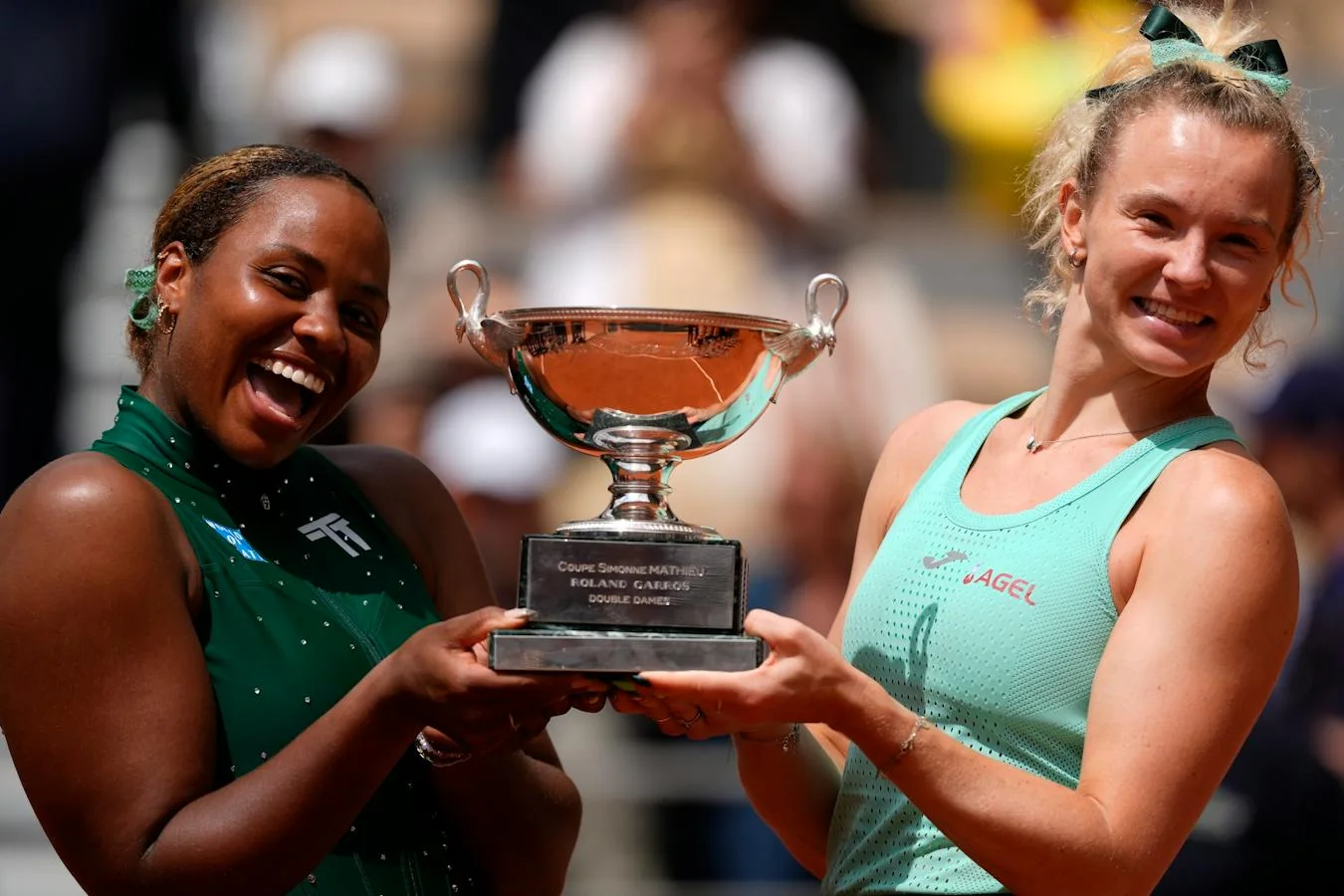
The women's doubles final brought the top two seeded teams together. No. 1 seeds Katerina Siniakova and Taylor Townsend defeated No. 2 seeds Anna Danilina and Aleksandra Krunic 6-2, 7-5 on June 7. The match lasted one hour and 32 minutes on Court Philippe-Chatrier. Unlike the singles final, this was a championship meeting between the pairs placed at the very top of the draw.
Siniakova and Townsend lost just one set in the tournament, in the second round against Emiliana Arango and Iva Jovic. Their semifinal was especially emphatic: a 6-0, 6-1 win over Gabriela Dabrowski and Luisa Stefani. That result established the level they could reach, but it did not mean Sunday's opponents were bound to offer the same kind of match. The final needed a more complicated finish.
Two set points separated them from a decider
After losing the opening set, Danilina and Krunic led the second 4-1. The top seeds worked their way back, then faced two set points with Townsend serving at 4-5, 15-40. They saved both and held for 5-5. A break in the next game gave Siniakova the opportunity to serve out the championship, which she completed.
The second set therefore deserves more attention than the phrase straight-sets victory might suggest. Danilina and Krunic had a substantial lead and later had direct chances to force another set. Siniakova and Townsend had to solve both situations. Recovering the earlier deficit got them back into contention; protecting Townsend's service game prevented that recovery from still ending in a lost set.
The title was their third Grand Slam together at the time of this final, following victories at Wimbledon and the Australian Open. It was also Townsend's first Roland Garros title and Siniakova's fourth women's doubles title in Paris. Those records describe overlapping achievements, rather than interchangeable ones. The partnership added a new tournament to its collection, while the players brought different histories to the same celebration.
That is why a women's results review benefits from keeping doubles alongside singles. Andreeva's first major and Chwalinska's qualifying run provided the singles breakthroughs; the doubles champions demonstrated how an established team could protect its position when a final became less comfortable. Their last set supplied a different form of drama, with a recovery and two saved set points hidden inside a two-set score.
What the results changed, and where to revisit them
At 19, Andreeva became the youngest women's singles champion at Roland Garros since Monica Seles in 1992. The historical comparison gives her age a precise frame. It also marks the most important change in how this tournament sits within her career: she had already reached a Paris semifinal in 2024, and now had the title itself. Progress was measured by a completed championship, rather than another prediction about her potential.
The immediate ranking effects were significant for both singles finalists. In the rankings published on June 8, 2026, Andreeva moved from No. 8 to No. 6. Chwalinska rose 93 places from No. 114 to No. 21. Those are the standings immediately after Roland Garros, rather than a statement of where either player ranks today. The latest WTA singles rankings provide the current comparison and display their own ranking date.
For Chwalinska, the jump put a number on the difference between arriving outside the top 100 and leaving with a Grand Slam runner-up result. It does not turn the final into a victory or guarantee what comes next. It does show why describing her Paris fortnight only through the five games she won in the final would miss the largest change produced by her run.
To revisit an earlier round, use the completed official 2026 draw. It preserves who actually met whom and where each result occurred. For the final's visual story, the organiser's Andreeva versus Chwalinska match highlights are dated June 6, 2026. A highlights package selects moments from a match; the complete score and round remain the reference when checking the outcome.
The WTA tournament calendar places this finished event within the wider clay-court season and the tournaments that followed it. This edition's identity is already clear: a teenager converted a strong second week into her first major, a qualifier won nine matches to reach an unprecedented Paris final, and an established doubles partnership recovered from set points down to add its first shared Roland Garros title. Each achievement is more informative when read through its own route to the final weekend.