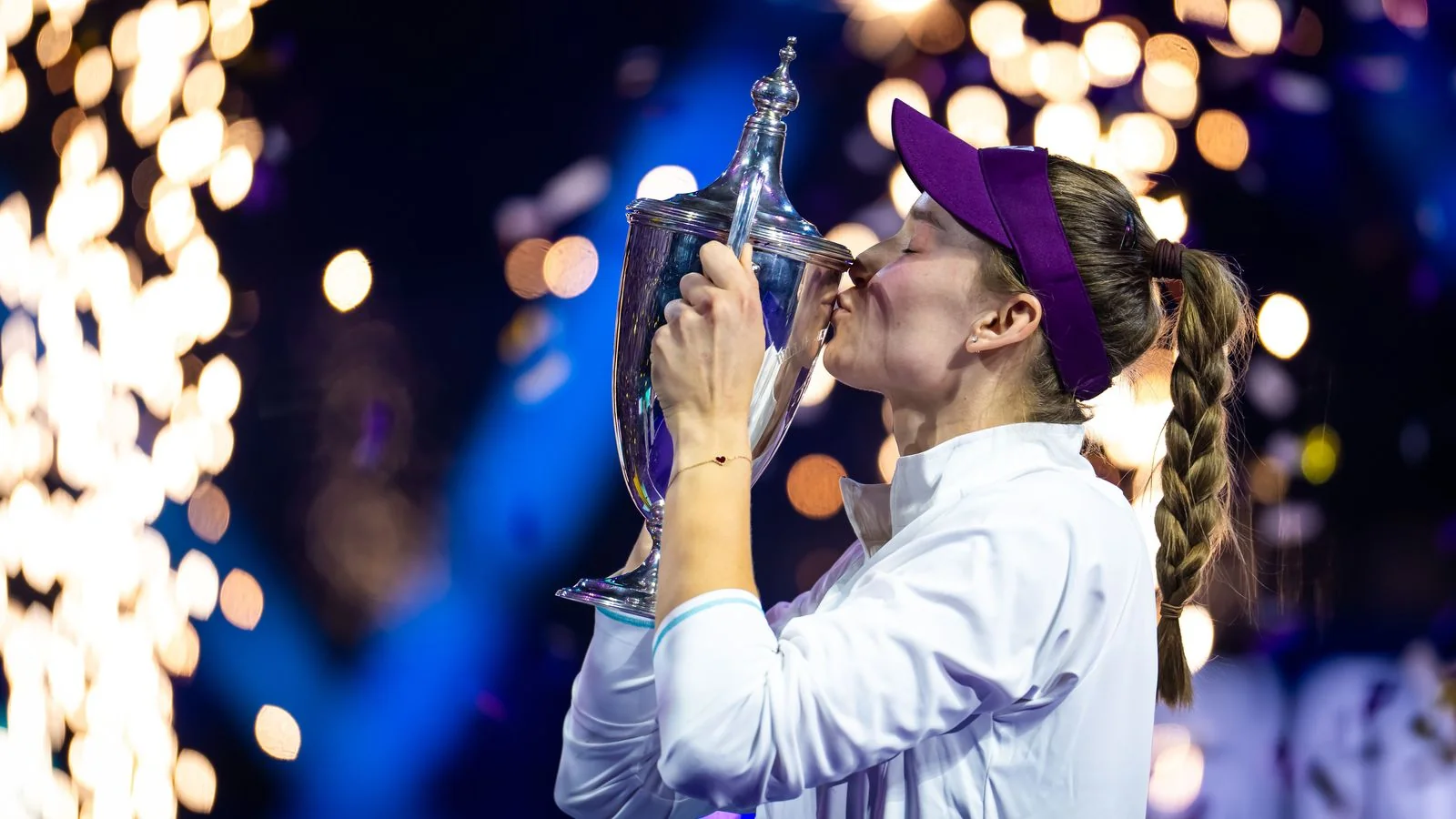
Elena Rybakina won the 2025 WTA Finals singles title, defeating Aryna Sabalenka 6–3, 7–6 (0). Veronika Kudermetova and Elise Mertens won the doubles championship against Timea Babos and Luisa Stefani, 7–6 (4), 6–1. Both finals were played in Riyadh on November 8, 2025.
WTA Finals 2025 results at a glance
The tournament ran from November 1 to November 8 at King Saud University Indoor Arena in Riyadh, Saudi Arabia, on indoor hard courts. The tables below describe the completed 2025 competition. They are historical results, separate from the 2026 WTA Finals standings and any current qualification race.
| Competition | Champions | Runners-up | Final score |
|---|---|---|---|
| Singles | Elena Rybakina | Aryna Sabalenka | 6–3, 7–6 (0) |
| Doubles | Veronika Kudermetova / Elise Mertens | Timea Babos / Luisa Stefani | 7–6 (4), 6–1 |
The WTA's dated singles final report and doubles final report identify the trophy winners. To understand how they reached that point, first read the group records, then move to the knockout results. The Finals used two phases, so finishing first in a group and winning the championship were separate achievements.
A group table covers the round-robin phase, scheduled for three matches per entrant. A withdrawal or alternate appearance can leave an individual with fewer completed matches. It cannot show the complete title race by itself. A semifinalist can carry the same group record as a finalist, while a group runner-up can ultimately win the trophy. Keeping those phases separate makes a 2025 standings search much easier to interpret.
Final singles group standings
Read these records as matches won and lost during the round-robin phase. The top two players from each group advanced. The names attached to the groups were labels for the competition, not players competing in it. Neither final group required a tie between identical win–loss records to determine its qualifiers.
Stefanie Graf Group
| Finish | Player | Record | Outcome |
|---|---|---|---|
| 1 | Aryna Sabalenka | 3–0 | Qualified |
| 2 | Jessica Pegula | 2–1 | Qualified |
| 3 | Coco Gauff | 1–2 | Eliminated |
| 4 | Jasmine Paolini | 0–3 | Eliminated |
Sabalenka won the group outright, while Pegula took the second semifinal place. The official archived draw supplies the completed records. A second-place finish was enough to stay in the title race; it did not mean that Pegula entered a separate consolation bracket. All four qualifiers played in the same semifinal stage.
Serena Williams Group
| Player | Record | Outcome |
|---|---|---|
| Elena Rybakina | 3–0 | Group winner; qualified |
| Amanda Anisimova | 2–1 | Second; qualified |
| Iga Swiatek | 1–2 | Eliminated |
| Madison Keys | 0–2 | Withdrew before third match |
| Ekaterina Alexandrova | 0–1 | Alternate; one match played |
The extra row matters. Keys withdrew with a viral illness, and Alexandrova played Rybakina in her place. Alexandrova's result belongs to Alexandrova; she did not inherit Keys' two defeats. Rybakina won that match 6–4, 6–4 and completed a 3–0 group campaign, confirmed by the WTA's November 5 report.
Anisimova secured the other place by beating Swiatek 6–7 (3), 6–4, 6–2, as recorded in the contemporary match report. If an older draw display lists Rybakina at 2–0, it has not incorporated the alternate match. For a completed-event summary, use the final 3–0 record and retain the withdrawal explanation rather than forcing every name into three matches.
Singles semifinal and final results
Both singles semifinals were played on November 7. The championship match followed on November 8. This is the knockout portion of the event: unlike a group defeat, a loss here ended the player's tournament immediately.
How the semifinal crossover worked
Each group winner faced the runner-up from the other group. Sabalenka therefore met Anisimova, while Rybakina played Pegula. The WTA semifinal preview confirms those pairings. The draw did not pit the two group winners against each other immediately; they could meet only if both won their semifinals.
| Round | Winner | Opponent | Score |
|---|---|---|---|
| Semifinal | Aryna Sabalenka | Amanda Anisimova | 6–3, 3–6, 6–3 |
| Semifinal | Elena Rybakina | Jessica Pegula | 4–6, 6–4, 6–3 |
| Final | Elena Rybakina | Aryna Sabalenka | 6–3, 7–6 (0) |
Sabalenka needed a deciding set against Anisimova, with a break for 4–3 proving decisive in the third. The official semifinal report describes the late pressure that separated them. Rybakina had a different route: she lost the opening set to Pegula before recovering to win the next two, documented in the Rybakina–Pegula report. An unbeaten match record does not mean a player never lost a set.
Rybakina defeated Sabalenka in the final
Rybakina broke for a 4–2 lead in the opening set and won the second-set tiebreak 7–0. Those were the decisive scoreboard moments in a 6–3, 7–6 (0) victory. The WTA final recap confirms the championship result.
The “(0)” is Sabalenka's point total in the tiebreak, not a separate set score or an unfinished match. Rybakina won two sets to none. For anyone comparing a compact results feed with a fuller scorecard, the same final may be displayed as 7–6 (7–0) in the second set. Both forms describe the same tiebreak.
What Rybakina's unbeaten title run tells you
Rybakina was the last singles player to secure a place in the 2025 field, clinching qualification in Tokyo. That is different from being the eighth seed: she was seeded sixth in Riyadh. The official qualification announcement places the late entry into its proper season context. Her route illustrates why the qualification story and the tournament results should be read separately.
Five wins across two different tournament phases
| Phase | Opponent | Rybakina's winning score |
|---|---|---|
| Group | Amanda Anisimova | 6–3, 6–1 |
| Group | Iga Swiatek | 3–6, 6–1, 6–0 |
| Group | Ekaterina Alexandrova | 6–4, 6–4 |
| Semifinal | Jessica Pegula | 4–6, 6–4, 6–3 |
| Final | Aryna Sabalenka | 6–3, 7–6 (0) |
Her 3–0 group record became a 5–0 tournament record after the two knockout victories. Counting the scorelines gives ten sets won and two lost. Swiatek and Pegula both took opening sets from her, so “unbeaten champion” means she won every match, rather than every set or every service game.
The semifinal against Pegula adds a useful detail beyond the headline: Rybakina served 15 aces while recovering from a set down, according to the dated semifinal account. The table nevertheless remains the clearest way to follow the sequence. It shows which opponents she faced, which phase each match belonged to, and where she had to come from behind.
For a fan revisiting the event, the Swiatek and Pegula matches offer the comeback chapters, while the final supplies the championship finish. Those are descriptions of this particular week. They do not establish how Rybakina will play against the same opponents in a later season, on a different surface, or with different recent form.
Final doubles group standings
The doubles competition also sent two teams from each group into the semifinals. Each row below describes a partnership's results in Riyadh. It does not describe either player's individual position in the world doubles rankings.
Martina Navratilova Group
| Team | Record | Outcome |
|---|---|---|
| Hsieh Su-wei / Jelena Ostapenko | 3–0 | Group winners; qualified |
| Veronika Kudermetova / Elise Mertens | 2–1 | Second; qualified |
| Sara Errani / Jasmine Paolini | 1–2 | Eliminated |
| Asia Muhammad / Demi Schuurs | 0–3 | Eliminated |
Kudermetova and Mertens qualified behind Hsieh and Ostapenko, then went on to win the trophy. That is the clearest example in this event of why the top row of a group table is not a championship declaration. The official 2025 draw archive separates the round-robin records from the later knockout bracket.
Liezel Huber Group
| Team | Record | Outcome |
|---|---|---|
| Katerina Siniakova / Taylor Townsend | 3–0 | Group winners; qualified |
| Timea Babos / Luisa Stefani | 2–1 | Second; qualified |
| Gabriela Dabrowski / Erin Routliffe | 1–2 | Eliminated |
| Mirra Andreeva / Diana Shnaider | 0–3 | Eliminated |
Babos and Stefani secured the second place by defeating defending champions Dabrowski and Routliffe 2–6, 7–5, [10–5]. Siniakova and Townsend completed their own group sweep with a 6–2, 6–4 win over Andreeva and Shnaider. Both results appear in the November 6 WTA report.
The bracketed [10–5] represents points in a deciding match tiebreak. It is not a third set containing fifteen games. This distinction becomes especially helpful when comparing doubles results with singles results: the first two sets may look familiar, but the deciding portion can use a different scoring format.
For Brazilian fans looking specifically for Stefani's finish, the group table answers only the first part of the question. She and Babos qualified second, won their semifinal, and finished runners-up in the championship match. Their final position in the tournament therefore cannot be read from the group number alone.
Kudermetova and Mertens won the doubles title
Both doubles group winners fell in the semifinals. Babos and Stefani defeated Hsieh and Ostapenko 6–4, 7–6 (5). Kudermetova and Mertens beat Siniakova and Townsend 4–6, 7–6 (6), [10–6], saving a match point along the way. The WTA semifinal report records both results.
The semifinals belonged to the November 7 session, although the latter match finished in the early hours of November 8 in Riyadh. If a results service gives it a next-day timestamp, that does not make it a different round or a separate match. Date displays can follow the session label, the local finish time, or the viewer's own timezone.
The championship match against Babos and Stefani
Kudermetova and Mertens won the November 8 final 7–6 (4), 6–1. They claimed their second WTA Finals title together, having also won in Fort Worth in 2022. They had reunited as a partnership in April 2025, according to the official championship report.
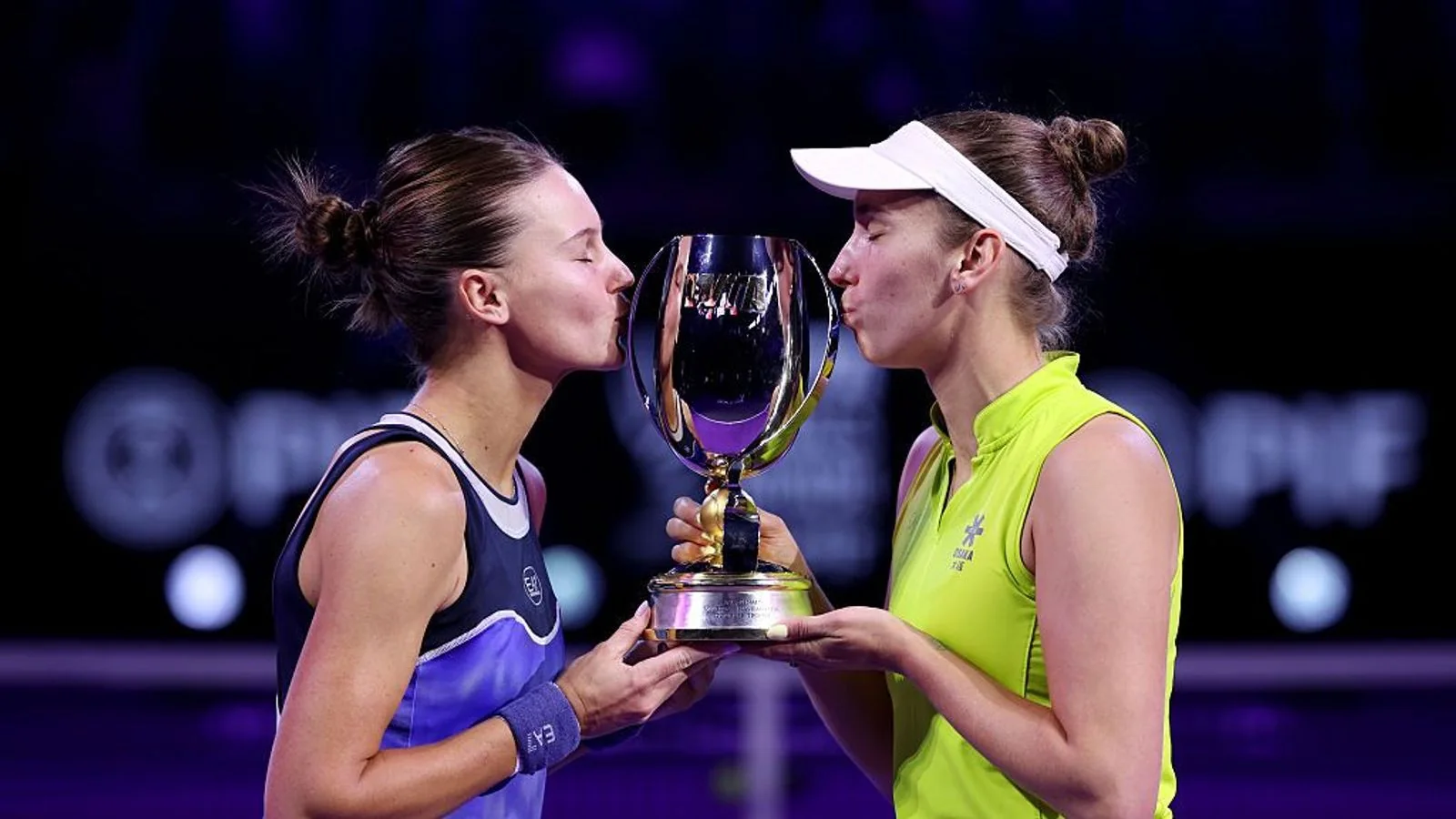
The first set was decided by a tiebreak, while the second ended with a five-game margin. The 7–6 (4) notation means Babos and Stefani scored four points in the first-set tiebreak. No deciding match tiebreak was needed because Kudermetova and Mertens won both regular sets.
The champions finished the week 4–1: two group wins, one group loss, then two knockout wins. Babos and Stefani finished 3–2, with two victories in their group and another in the semifinal. Those complete-week records are different from the 2–1 records that both teams carried into the knockout stage.
This distinction also explains why a single group defeat did not end Kudermetova and Mertens' challenge. Round-robin play offered a route back into contention. Once the semifinals began, however, there was no second chance. Their saved match point was therefore a championship-preserving moment, rather than just a detail affecting the group order.
Ranking points and prize money from the 2025 Finals
The 2025 tournament offered a total prize fund of $15.5 million. Ranking points were awarded for each victory: 200 for a round-robin win, 400 for a semifinal win, and 500 for winning the final. The WTA's dated 2025 tournament guide sets out those amounts for both draws.
Rybakina's five wins produced 1,500 points: 600 from her group matches, followed by 400 and 500 in the knockout rounds. Kudermetova and Mertens earned 1,300 doubles points each from their team's four victories: 400 in group play, 400 in the semifinal, and 500 in the final.
The difference between those totals comes from the champions' group records, not from the value of the final. Rybakina collected the undefeated singles champion's $5.235 million. The published payout for a doubles championship campaign with one group loss was $1.067 million per team. A partnership's prize award should not be described as an identical amount for each player.
These are event awards. They are not necessarily the increase visible in a player's next weekly ranking total, which can also reflect results leaving the ranking calculation. Likewise, an announced purse is not a statement of a player's personal net income after private expenses or taxes.
A Finals title is different from year-end No. 1
Sabalenka finished 2025 as the singles world No. 1 even though Rybakina won the Finals. The WTA's year-end singles announcement recognizes the season-long ranking achievement. In doubles, Siniakova secured year-end No. 1 despite her team's semifinal defeat.
The tournament trophy answers who won this event. The ranking answers who led the applicable ranking calculation across the season. There is no contradiction when different players receive those honors. For today's positions, use the current singles rankings or current doubles rankings; neither is a replacement for this historical event table.
How to use the 2025 tables without mixing seasons
Start with the question you want answered. “Who won?” calls for the championship result. “Who qualified for the semifinals?” calls for the final group table. “Who finished the season highest?” calls for the year-end world rankings. A search for a Finals “table” can lead to any of these, but they describe different achievements.
A number beside a player's name in an archived draw is usually the tournament seed. Rybakina's sixth seed in Riyadh should not be confused with her fifth-place finish in the 2025 year-end rankings, confirmed by the WTA's November 10 season wrap. Neither number is her position in today's ranking.
For the next season's competition, open the separate 2026 singles standings or 2026 doubles standings. Keep the year in view when comparing editions, especially in doubles, where partners may change. To find matches being played now, use WTA matches today. This page remains a completed 2025 results reference.