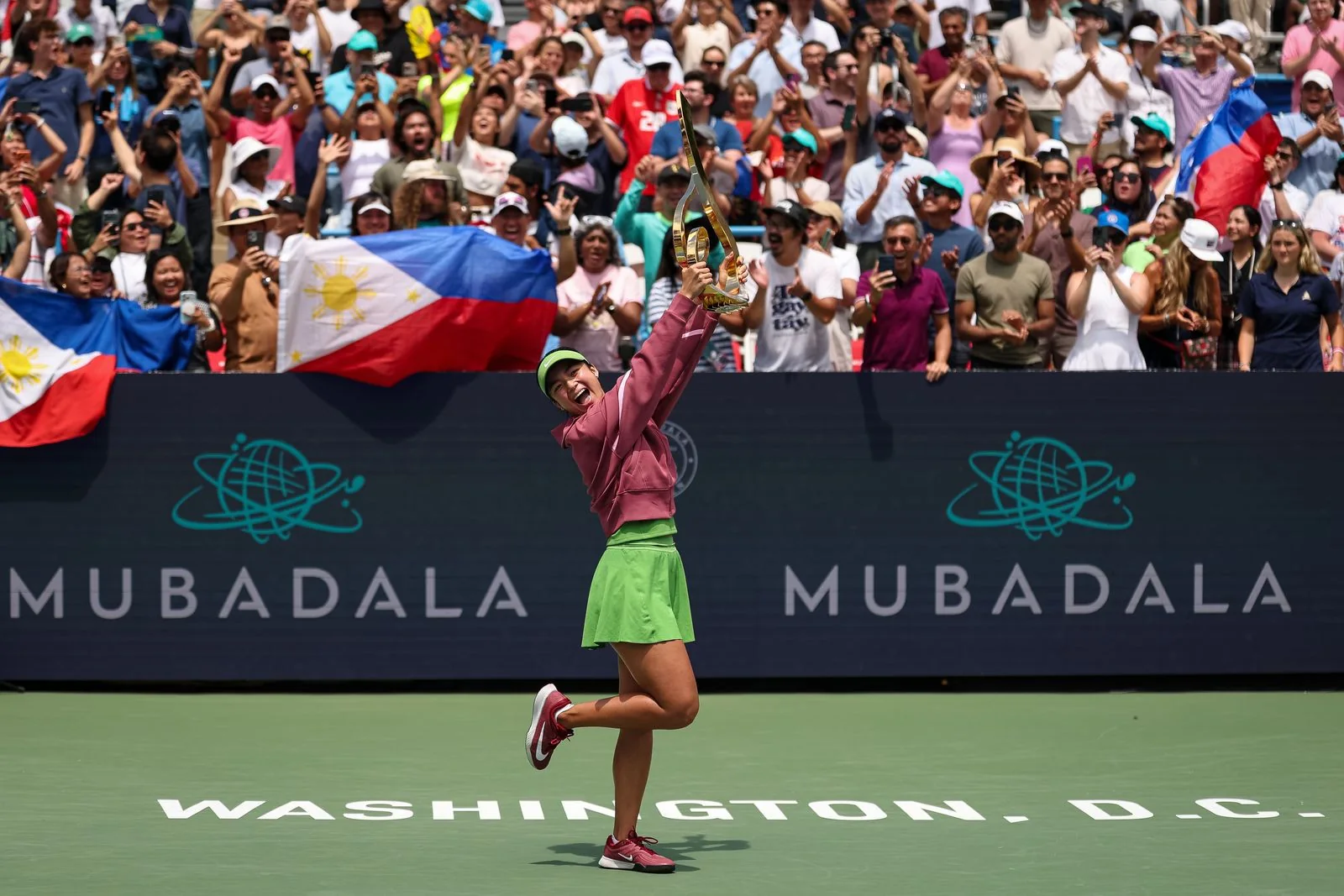
Eala won a fan vote, not a ranking of hard-court results
Alexandra Eala won WTA Star of the Hard-Court Swing because she received the largest share of the fan vote. The official result announced on September 25, 2026 gave Eala 78 percent and Elena Rybakina 16 percent. It was a public-vote award, rather than a calculation that placed a Washington title above the US Open or changed the world rankings.
That distinction answers the central question behind the controversy. Rybakina's supporters could make a powerful case that winning the US Open was the greatest competitive achievement of that stretch. Eala's supporters could still vote for the player whose breakthrough or personality meant the most to them. The mechanism did not require the final percentages to mirror tournament points.
The WTA's final announcement explicitly identifies the outcome as a fan vote. It does not describe Eala as the highest-ranked player, the US Open champion, Player of the Month or the season's year-end best player. Those distinctions matter when a short headline leaves out the award's full name and voting method.
This was a September result, reviewed here on October 29. Later Asian events cannot retroactively determine what happened in that earlier poll. Nor should a player's current ranking be substituted for the ranking or achievements being discussed at the time. Keeping the period clear allows a fair comparison of what each player actually did during the relevant swing.
The useful debate is therefore about what the title communicates and whether public voting is an appropriate way to select its winner. It is not a match Eala won against Rybakina, and no sporting result was reversed. To assess the criticism, first establish the published vote, then consider the two players' different sporting stories and the expectations people brought to the word “star.”
What the published voting result actually tells us
The final result has a clear numerical meaning: among the votes reported for this poll, Eala received a much larger share than Rybakina. The difference was 62 percentage points. It does not mean that 78 percent of everyone who follows tennis preferred Eala, or that Eala performed 62 percent better on court.
Final percentages are different from live-poll snapshots
A September 22 Tennis365 report described an earlier snapshot: more than 3,700 votes, with Eala on 74 percent and Rybakina on 19 percent. The official September 25 announcement later gave 78 percent and 16 percent. These are different stages of a developing poll, rather than conflicting final results.
| Published stage | Eala | Rybakina | What it represents |
|---|---|---|---|
| September 22 report | 74% | 19% | An interim position while voting was being discussed |
| September 25 WTA announcement | 78% | 16% | The published final result |
A changing percentage is normal when more votes are added. For a hypothetical poll, an initial hundred participants and the next thousand need not have the same preferences. A candidate's share can rise even while another candidate also receives additional votes. Percentages alone do not reveal each candidate's raw total, and the earlier 3,700 figure must not be reused as the final turnout.
The published outcome also does not provide a representative survey of national fan populations. Participation is self-selected: people who see the invitation and choose to respond make the result. Fans who never saw the poll are not counted. A broad claim about all tennis viewers would require information the announcement does not supply.
WTA's result page gives the winner, leading percentages and sporting context. It does not publish the complete ballot dataset, a geographical voter breakdown or a technical voting audit. There is therefore no basis here for calculating how many Filipino fans voted, comparing national turnout rates or declaring a particular security failure. What can be stated confidently is the outcome that WTA announced, with its actual scope preserved.
Eala's hard-court swing had a sporting story of its own
Reducing Eala's candidacy to “she has fans” misses the tennis that gave those supporters something to celebrate. Her Washington breakthrough was a significant achievement in its own right. It can be recognized accurately without pretending that a WTA 500 title has the same status as winning a major.
The Washington title was a career breakthrough
Eala became the first player from the Philippines to win a WTA Tour singles title when she beat Jessica Pegula in the rain-delayed Washington final on August 3. The tournament's account records a path through Zheng Qinwen, defending champion Leylah Fernandez, Elina Svitolina and Naomi Osaka before the final. This was a demanding run through established opponents, not a title obtained without meaningful opposition.
Her WTA Champions Corner interview describes what a first tour title meant to her and how the week carried her into the top 20 for the first time. That is a dated milestone, rather than a claim about her exact ranking now. For a developing player, converting an important final can change the story supporters tell about her progress.
There are at least two ways to evaluate such a week. A results comparison asks about the level of the title and the quality of the opposition. A breakthrough comparison asks how far the player has moved beyond previous achievements. Those questions can produce different answers without either needing invented statistics. The first emphasizes competitive scale; the second emphasizes a personal and national first.
A memorable US Open match can matter to supporters
Eala's swing also included a three-hour US Open defeat against Iva Jovic. The official match report describes a demanding contest; the award announcement also recalled their embrace afterward. A loss remains a loss in the draw, but the way a player competes and responds can still shape a supporter's impression.
It would be speculation to calculate how much that moment contributed to Eala's vote share. The ballot result does not break voters down by motivation. A supporter might have voted because of Washington, because of an emotional match, because of a longer attachment to Eala or simply because she was their favourite nominee. These are possible explanations, not measured findings about this electorate.
Our Eala Cincinnati article provides another part of her hard-court schedule. Looking at the swing as a sequence of performances makes her story more substantial than a popularity label. It still leaves room to conclude that Rybakina produced the stronger headline achievement, which is why the poll and the sporting comparison should not be treated as interchangeable verdicts.
Why Rybakina had the stronger major-title argument
If the question is who produced the biggest major-tournament achievement of the North American hard-court swing, Rybakina has the compelling answer. She beat Aryna Sabalenka 6-4, 5-7, 6-2 in the US Open final on September 12. It was her first New York title and her third career Grand Slam singles championship, as documented in the WTA final report.
That sporting argument does not depend on diminishing Eala. A major title and a first WTA 500 title are different achievements on different scales. A performance-led assessment can recognize Washington as a breakthrough while assigning greater weight to winning the US Open. The fan-vote result did not require anyone to abandon that hierarchy when evaluating the actual tennis.
The US Open title and world No. 1 were separate achievements
The US Open's official account also records her rise to No. 1 with the rankings update on Monday, September 14. Its post-final feature explains that she had already secured that ranking milestone before the championship match. The final added the trophy; it was not a single winner-takes-No.-1 match.

The distinction matters when comparing claims of recognition. A tournament trophy records victory through that event's draw. The world ranking summarizes eligible results under a points system. A public poll records the preferences of participants. These are three different kinds of evidence, and a less successful poll cannot cancel the first two.
Rybakina had also won the Australian Open earlier in 2026, but that occurred outside this North American swing. It belongs in her season's wider context rather than being counted as another title inside the award period. The US Open alone is sufficient to understand why many viewers expected her to lead a performance-based comparison.
That is the strongest form of the objection: the name sounded to some fans like a verdict on the best tennis, whereas the winner was selected through participation in a poll. There is no need to convert that disagreement into a claim that Eala's title was worthless or that Rybakina lost a sporting honour already earned on court.
Why the award's name divided tennis fans
The disagreement was partly about language. In the discussion of the award, some commenters wanted a label such as fan favourite, while others argued that “star” already allows popularity and personal connection to matter. That is a substantive difference in expectations, even when everyone understands that voting took place.
Popularity and performance answer different questions
To one reader, the star of a sporting period means its best performer. To another, it means the person who created the strongest connection with an audience. A player can lead one comparison without leading the other. The word carries both possibilities, which makes the selection method especially important when communicating the result.
There is a reasonable criticism here: sporting achievements make the shortlist meaningful, so readers may expect those achievements to decide the winner too. But nomination and final selection can use different principles. A shortlist of successful players followed by a fan vote asks supporters to choose among relevant candidates; it does not necessarily instruct them to reproduce a points table.
Our editorial preference would be to make the method visible wherever the result is announced. Three possible designs would communicate different purposes:
- A fan-favourite award can openly celebrate participant preference and the supporters who turn out to vote.
- A performance award needs declared criteria such as results, event level or a judging panel's sporting assessment.
- A combined award needs its voting and judging weights explained before selection, so the final result can be understood.
These are design suggestions, not announced WTA changes. None requires pretending that popularity is sporting inferiority or that a major title is merely a matter of taste. They identify what each type of award is supposed to tell the audience.
A large fan vote does not establish manipulation
Some coverage used language about a poll being hijacked. That is an allegation or metaphor in the discussion, not a demonstrated finding that ballots were fraudulent. A lopsided result can arise when supporters of one nominee participate more actively. The published percentages alone cannot distinguish ordinary mobilization from a technical voting problem.
Calling Eala's votes invalid would require evidence about a breached rule or an identified irregularity. The official result cited here does not announce such a finding. Nor does it identify voters by nationality. It would be inaccurate to treat every vote for a Filipino player as proof of a Filipino voter, then use that assumption to criticize a whole national community.
The strongest criticism remains directed at the award's purpose and presentation. It is entirely possible to prefer Rybakina on performance, appreciate Eala's breakthrough and want clearer naming. Those positions allow discussion of the system without turning ordinary support for a nominated player into an accusation of wrongdoing.
What this award changes for Eala and Rybakina
For Eala, the result adds an officially announced piece of fan recognition to a period that already included her first tour title. It demonstrates strong support among the people who participated. That is a meaningful description of this particular outcome without trying to turn it into a prediction of future titles or a measurement of every tennis fan's preferences.
For Rybakina, finishing second in the poll changes neither the US Open result nor the ranking milestone she earned. Tournament points, rather than this fan award, determine the official standings under the WTA ranking rules. Her case for having produced the swing's most significant major result remains assessable from the actual draw and final.
The practical difference is straightforward. A fan selecting a memorable player can value connection, progress or an admired moment. Someone deciding which player had the strongest competitive swing should compare results within the same period, give tournament levels appropriate weight and state the criteria. Someone checking who is No. 1 should use the dated official rankings. None of those tasks is answered simply by copying a percentage from the other.
Our guide to live rankings and the Race explains why even two points-based lists can answer different questions. The current rankings and matches today pages help follow the players' subsequent sporting progress. Later performances should be judged on their own evidence, rather than used to defend or attack a September popularity result.
The clean reading of the award is specific: Eala won the published fan vote; Rybakina won the US Open and reached world No. 1. A reader can regard Rybakina as the stronger performance choice while accepting that Eala legitimately won the award as it was presented. The remaining disagreement is about what recognition the words “Star of the Swing” ought to communicate, and whether a clearer label would make the next vote easier to understand.