Why Swiatek stopped playing in October 2026
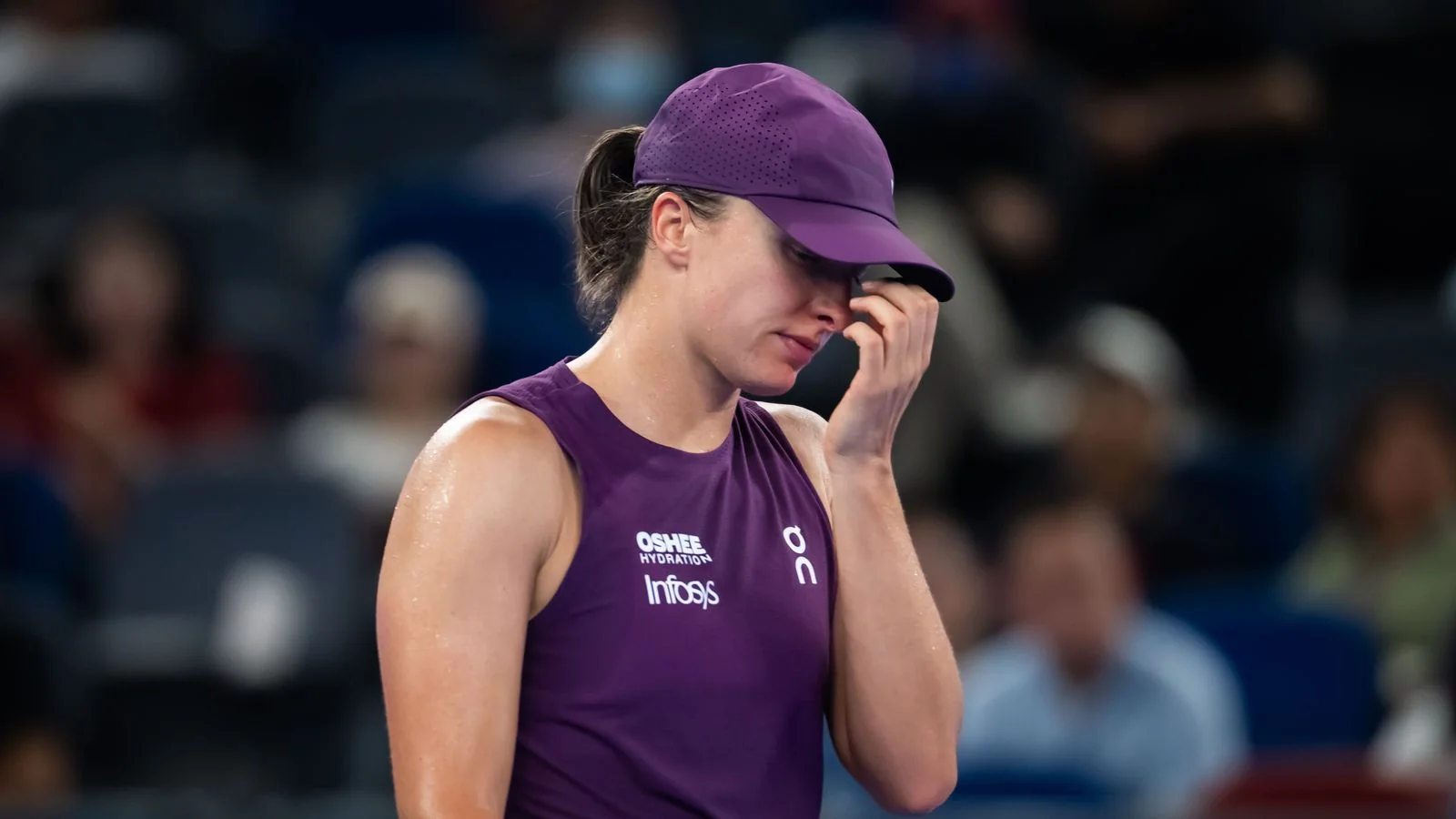
Iga Swiatek ended her 2026 season after withdrawing from the Ningbo Open because of an ongoing left thigh problem. Her October 20 announcement made the priority clear: she wanted time to recover fully after a demanding period. She subsequently confirmed that she would play no more tournaments this year.
The decision ended her active pursuit of a WTA Finals place. It also changed the meaning of the remaining Asian schedule for her supporters. This was no longer a case of skipping one tournament while waiting to see whether she would appear at the next one. Her statement expanded the absence to the rest of the competitive year.
The Ningbo withdrawal and the season-ending decision
Withdrawing from Ningbo and ending the season are related announcements with different scopes. A tournament withdrawal removes a player from that event. It does not automatically rule her out of later tournaments. Swiatek made the broader decision explicit, which is why older Tokyo field previews or qualification scenarios should no longer be treated as current plans for her.
She had been the second seed in Ningbo. Anastasia Zakharova replaced her in the draw, according to the WTA's October 20 report. Swiatek did not lose a Ningbo match: she withdrew before taking part. That distinction is relevant when reading a results page, a tournament recap or an automated season record.
Her message also acknowledged progress during the second half of the year. That gives the decision a more specific context than the suggestion that she had simply stopped caring about the season. A player can value recent improvements and still decide that further competition is the wrong next step. Continuing to enter tournaments is not the only way to act on a longer-term sporting objective.
For fans, the useful immediate answer is therefore straightforward. The absence has an announced physical reason, and the end of the season was her stated choice. It does not require a speculative account of private disagreements, motivation or the seriousness of an undisclosed diagnosis. The Ningbo event guide covers what happened in the tournament after its field changed.
What is known about the left thigh problem
The confirmed description is an ongoing problem with Swiatek's left thigh over the preceding weeks. The public announcement does not provide a detailed diagnosis, an injury grade or a fixed recovery period. “Thigh injury” should therefore be read at that level of specificity. It would be misleading to turn it into a named muscle tear or attach a standard number of weeks to her absence.
There is relevant match context. Swiatek was affected during the Wuhan semifinal against Maja Chwalinska on October 17. The official match report describes a medical timeout after Chwalinska saved two set points in the ninth game of the first set. Chwalinska ultimately won 7-5, 6-1. The later withdrawal announcement links the physical issue to that recent period of competition.
A medical timeout and a later withdrawal answer different questions. The timeout concerns whether assessment or permitted treatment can take place during a match. Withdrawal concerns whether the player will take part in an event. Completing the Wuhan match did not establish that Swiatek was ready for another tournament, just as a later withdrawal does not retroactively change the match result.
Photographs of a bandage, a player stretching or a difficult movement can illustrate what happened on court. They cannot establish the exact underlying injury. The same limit applies to a supporter noticing that one stroke or direction of movement looked uncomfortable. Those observations may explain concern, but the player's announced condition remains the factual description available to the public.
It is also possible to acknowledge the injury without reducing Chwalinska's win to an asterisk. The official result stands, and the winner still had to recover from a first-set deficit and finish the match. Discussing Swiatek's availability is a different task from assigning an imagined score to a match played under different circumstances.
The most useful boundary for readers is between the stated reason and an inferred prognosis. Swiatek has explained why she stopped. She has not supplied enough public detail to say how severe the problem is, whether it will recur or exactly when full competition will be appropriate. Those unanswered points do not justify filling the gap with a confident prediction.
What her decision means for the WTA Finals
Swiatek's season-ending announcement closed her active bid for the year-end championships. By October 21, the WTA had confirmed Karolina Muchova as the eighth and final singles qualifier. The completed field also includes Elena Rybakina, Aryna Sabalenka, Mirra Andreeva, Linda Noskova, Coco Gauff, Jessica Pegula and Elina Svitolina. A report written while the final place was still available describes an earlier stage of that process.
Qualification is based on the season Race
The Finals uses the Race to identify its qualifiers, with the relevant provision for current-year Grand Slam champions. It does not simply take a screenshot of the rolling singles ranking and invite those eight names. Swiatek's position in the ordinary ranking therefore cannot, by itself, establish that she should have been in the Finals field.
The October 26 tables illustrate the distinction: she is eighth in the rolling ranking but ninth in the Race. The two lists cover different periods and can legitimately disagree. Previous achievements and a familiar place near the top of the sport do not provide a discretionary career-champion invitation. The published qualification criteria still determine the field.
The 2026 qualified-player guide follows the confirmed entrants. It is a better place to find the actual field than an early October prediction that still described several players competing for one vacancy.
An alternate place is a different commitment
A recurring question in the fan discussion of her announcement was why she would not wait as a possible alternate. An alternate is a potential replacement, rather than a ninth player guaranteed a normal set of tournament matches. A place in competition depends on a vacancy and the applicable replacement rules.
The 2026 rulebook also makes alternate status a real commitment: designated alternates have arrival, attendance and availability obligations. It is not simply a request to keep a phone switched on at home. That distinction explains why “she could still be an alternate” does not answer the question of whether she is available for more competition.
It would go beyond the evidence to assign her a private motive involving money, pride or travel, or to claim that a particular formal invitation was offered and refused. The public reason is that she is ending the season to recover. Once a player has announced that she will not compete again that year, a theoretical route through the reserve list does not override that decision.
Reading her 2026 season beyond the injury headline
Swiatek's sole tour singles title in 2026 came in Toronto, following a 2025 season with titles at Wimbledon, Cincinnati and Seoul. The reduction in trophies helps explain why this year felt disappointing against her established standard. It should not obscure the distinction between falling short of a champion's expectations and becoming unable to compete with leading players.
Her career already includes the 2023 WTA Finals championship and major titles on clay, hard courts and grass. That history shapes the reaction to a season without a major title. Supporters are comparing her results with an unusually demanding personal benchmark. It is reasonable to discuss the gap, but the benchmark should be named rather than quietly treating a successful career as the minimum ordinary outcome for every year.
Toronto and Wuhan show why the late-season context matters
Toronto supplies a concrete example of the level she still reached. Swiatek defeated Rybakina 6-2, 6-3 in the August 13 final, completing the match in 75 minutes. Her tournament also included wins over Marta Kostyuk, Diana Shnaider and Svitolina. This was a substantial title run through established opposition, not a minor statistical consolation attached to an otherwise empty season.
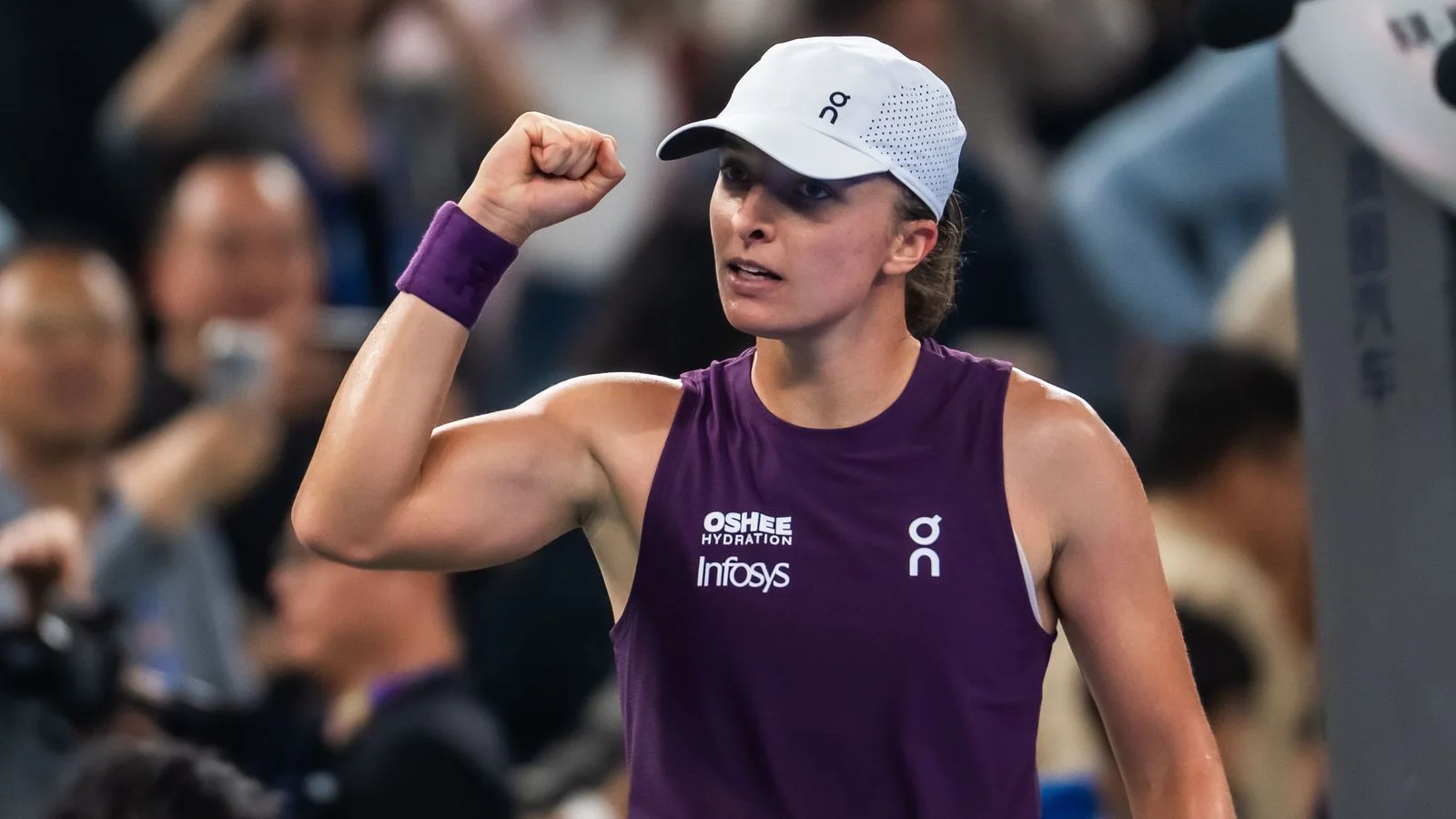
In Wuhan, she reached the semifinals without dropping a set, beating Magdalena Frech, Ashlyn Krueger and Ann Li. The quarterfinal against Li finished 6-4, 6-1 in 93 minutes. She saved all three break points faced, and the WTA reported that she won 74 percent of first-serve points and 60 percent behind her second serve.
Those details give substance to her statement about second-half progress. They do not prove that every part of her game had been fixed, but they show an ability to manage a close opening set and then separate from the opponent. Wuhan was her fourth WTA 1000 semifinal of the season, and reaching it completed her career set of semifinals at all ten current tournaments in that category.
The subsequent injury decision sits alongside those results. It does not erase Toronto or the Wuhan wins, and those wins do not invalidate the need to stop. The season ends with both a meaningful title and an unresolved physical interruption, rather than a single verdict that everything was either restored or lost.
Why an earlier finish does not mean months without work
Swiatek's announcement prompted supporters to count the weeks until the next season. The calendar does give her a longer interval without tournament play than a player competing through the November 15 WTA Finals singles final. October 20 is 26 days earlier. That difference is meaningful, but it should not be converted into an assumption that she will spend every day of the interval resting completely.
A tennis season contains more than match dates. Travelling between events, adjusting to conditions, preparing for opponents and remaining ready for the next match are part of the competitive routine. A deep tournament run can mean several consecutive days organised around recovery and the next contest. Leaving the tournament circuit changes that rhythm even before any specific future training plan is announced.
There are also different kinds of work that a player might undertake away from tournaments: physical preparation, technical practice and planning with the coaching team. Those examples explain why “not competing” and “doing nothing” are different descriptions. They do not reveal Swiatek's private schedule, which she has not set out in detail here.
For a player working with Francisco Roig, as listed on her official profile, an uninterrupted period may offer a different setting from making adjustments between matches. A training block can focus on repeatable tasks without the immediate requirement to win the next round. Whether that produces a particular technical change or result next season remains to be seen.
The ranking incentive pulls in another direction: a tournament offers a chance to earn points only if a player enters and progresses. The opportunity cost of stopping is real, especially near a qualification cutoff. But comparing potential points alone leaves out the purpose Swiatek actually identified, which was to recover fully. A points table cannot measure whether an extra week of competition is compatible with that objective.
Supporters can therefore understand the longer break as a change in priorities for the remainder of the year. Her public commitment is to stop tournament play, rather than to meet a particular online prediction about how quickly she should recover or how much training she should complete. The value of the decision will be assessed over time, through her own updates and eventual return to competition.
What to expect from the next confirmed update
As of October 29, the announcement establishes the end of Swiatek's tournament season. It does not establish her first match back. The next useful information will be an update from her or an official event confirming a future appearance, followed eventually by the draw and order of play for the relevant tournament.
A return date needs its own announcement
Australia is an obvious focus for supporters looking toward a new tennis season. It is not enough, however, to assume that the Australian Open must be her first tournament back. Players can select preparation events, adjust entries or change plans. A calendar showing when a competition exists is different from a player confirming that she will take part.
Swiatek has won the other three majors, making Melbourne a continuing career storyline. That gives fans a legitimate sporting question for 2027, but it does not convert a possible achievement into a promised target date or outcome. Her eventual schedule and competitive readiness will provide the context for a proper preview.
The same distinction applies to exhibition appearances discussed online. Exhibitions and tour tournaments have different formats and consequences for rankings. A season-ending statement alone should not be used to confirm or cancel every separate appearance. A specific event needs its own current information, rather than an inference from the general announcement.
How fans can follow her schedule without relying on old entry lists
The WTA calendar is useful for locating upcoming events; an updated tournament field explains who is entered. Once the draw is made, it identifies the opponent. The order of play then supplies the day's match sequence. Each stage answers a more precise question than the one before it.
For rankings, use the dated singles table rather than treating the No. 9 attached to the original injury report as a permanent label. Her position can change while she is away because other players earn points and older results leave the rolling system. Movement during the break does not mean that she has returned or played an unreported match.
Her 2026 campaign is now a completed competitive chapter. The concrete story is an injury-related stop after a season containing a major tour title and a late Wuhan semifinal. The first confirmed return appearance will begin a different chapter, with its own opponents, preparation and expectations.