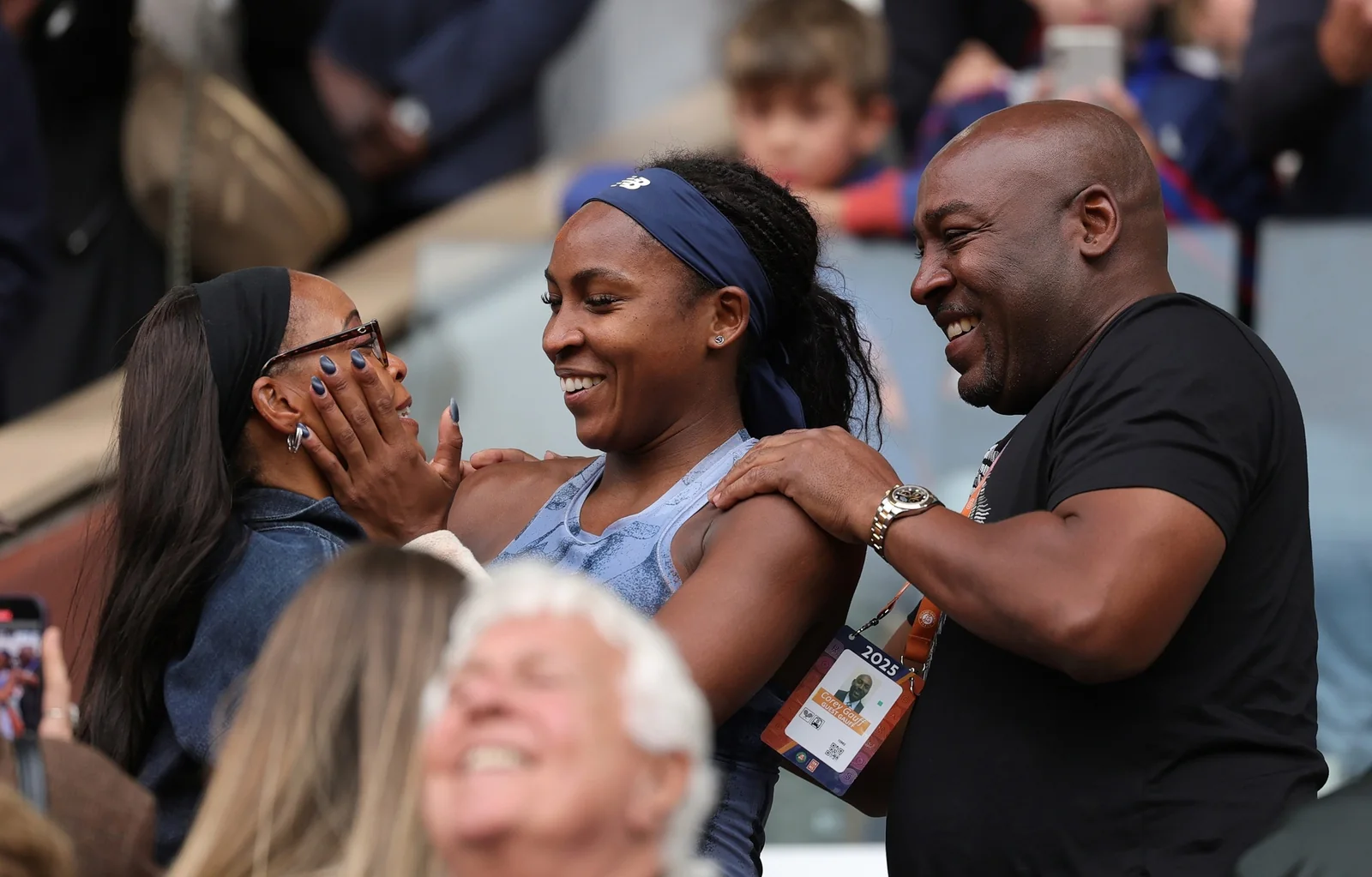
Coco Gauff's parents are Corey and Candi Gauff. Both competed in college sports: Corey played basketball at Georgia State, while Candi competed in track and field at Florida State. Corey helped coach Coco early in her tennis development; both parents have remained important supporters as her professional team has changed.
Who are Coco Gauff's parents?
The family is often visible after Gauff's biggest matches, but their connection to her tennis began well before the trophies. ABC's June 2025 family profile names Corey and Candi and identifies Coco's two younger brothers, Codey and Cameron. The family story involves education, travel and everyday support as well as competition.
Corey Gauff's basketball background
Corey's college sport was basketball, rather than professional tennis. The USTA's 2018 profile identifies his Georgia State background. It is useful context for understanding a parent comfortable with athletic training and competition, but it should not be confused with a career on the WTA or ATP Tour.
His later work with Coco required learning the demands of a different sport. Being an experienced athlete can inform patience, preparation and communication without supplying every technical answer about a tennis stroke. The distinction helps explain why a family-led start and specialist professional coaching can coexist in one player's development.
Candi Gauff's athletics background
Candi's sporting experience included gymnastics and track and field, according to Coco's official WTA biography. ABC describes her as a Florida State heptathlete. Her background therefore extended across several athletic skills rather than one tennis-specific role.
A fan looking at the player box should not assume that only the person giving tactical advice matters. Parents can help a travelling athlete maintain routines, perspective and a familiar connection away from home. Those contributions are different from deciding a return position or changing a service motion, but they still belong in an account of the people around Gauff.
How the family built a tennis foundation in Florida
Gauff spent part of her childhood in Atlanta before the family moved to Delray Beach, Florida, to support her training. A 2020 report on her preseason preparation describes that Florida base. The location matters as a setting for regular work, rather than simply a hometown label attached after she became famous.
A father-coach who learned alongside his daughter
Corey became more involved after leaving his healthcare executive job on June 13, 2016. In a June 2021 USTA interview, he explained that an early Atlanta instructor known as Coach Little helped teach both Coco and him. He also credited Jewel Peterson, Gerard Loglo and Sly Black for their contributions during her formative years.
That account is more specific than saying a single coach created the champion. Peterson helped build belief and persistence, while other instructors supplied elements of the tennis foundation. Corey described a progression through introductory tennis, junior competition and ITF events. Early success moved Coco along that pathway quickly; it did not mean those stages were absent.
For someone watching her later matches, the names explain why the story has several layers. A parent can organize practice and learn alongside a child while drawing on teachers with different experience. Later, touring coaches can inherit that foundation and work on the challenges of professional competition. These roles do not have to compete for a single “discovered her” credit.
Corey's 2025 Tennis Channel interview emphasized giving Coco opportunities while allowing the desire to play to be hers. He framed the family's effort around personal growth rather than a requirement to accumulate trophies. That is his account of their approach, rather than a claim that every aspiring player needs the same household arrangement.
The practical distinction is between support and a guarantee. Relocating, finding coaches and making time for training can create opportunities; the player still has to compete, recover from losses and make decisions. Gauff's family provided a base from which her own tennis developed, rather than a formula that makes a Grand Slam title inevitable.
Academy support and the junior breakthrough
Alongside her family and early instructors, Gauff gained access to a wider training network. Her development combined a Florida base with experiences abroad, and her junior results offered a route into professional events. Those are related parts of the journey, but they are not the same achievement.
What the Mouratoglou connection actually means
The Mouratoglou Academy's own account says Patrick Mouratoglou and his team identified Gauff at ten and that she joined the ChampSeed programme. It describes training visits at different stages of her development. The connection provided support and access to an academy environment.
An academy association should not be translated into a claim that Mouratoglou was her sole full-time touring coach throughout her career. Mentoring, training facilities and daily match preparation are different roles. Her father, early instructors and later professional coaches remain part of the story even when a headline emphasizes a famous academy name.
The 2018 Roland-Garros junior title
At fourteen, Gauff won the 2018 Roland-Garros girls' singles title against Caty McNally, 1–6, 6–3, 7–6(1). The dated WTA final report distinguishes that title from her runner-up finish at the 2017 US Open girls' event. Paris supplied an important junior championship before the much broader public attention of Wimbledon 2019.
She subsequently reached junior world No. 1 in July 2018, a milestone covered by the USTA's July report. The ITF's 2019 retrospective records that she ended 2018 second in the junior rankings. Reaching the top during the season and finishing the season there are different records.
The same ITF account explains her use of the Junior Exempt pathway when entering professional competition. A strong junior finish can help a player gain entry opportunities, but it does not transfer the junior ranking into the WTA standings. The player must earn professional results in the professional draws.
For fans revisiting the early highlights, keep “girls' singles” beside the 2018 Paris title. Her women's singles championship at the same venue came in 2025. The seven-year interval is part of the development story: the junior win was a foundation, while the senior title required succeeding against a different field at a later stage.
Wimbledon 2019 brought her into the spotlight
On July 1, 2019, fifteen-year-old qualifier Gauff defeated Venus Williams 6–4, 6–4 in Wimbledon's first round. The WTA's report that day captures the significance of meeting a five-time champion in her Grand Slam main-draw debut. Gauff's admiration for the Williams sisters made the matchup especially meaningful.
She reached the fourth round before losing to eventual champion Simona Halep. It was a breakthrough run, rather than a Wimbledon title. For many viewers, it was their first sustained encounter with Gauff's tennis; for her family and earlier coaches, it followed years of preparation and junior competition.
Qualifying is also part of the result. Gauff had to earn a main-draw place before that opening-round match. When a highlight begins with the handshake against Venus, it leaves out the matches that brought her to that court. The public introduction was sudden, but the competitive work behind it was not confined to one afternoon.
Later that season she won her first WTA singles title in Linz. The October 13 final report records a 6–3, 1–6, 6–2 victory over Jelena Ostapenko. Gauff had entered the main draw as a lucky loser after losing in qualifying, then made the most of the available place.
In the following day's reflection, Gauff discussed meeting her season goals and described the week as a significant step. A tour title supplied something different from a famous upset: success through the final round of an entire tournament.
These two 2019 milestones make a useful pair. Wimbledon showed her competing convincingly on a major stage; Linz showed her completing a tour-level championship. Neither meant her game was finished developing. The coaches and priorities that mattered at fifteen would not remain identical as she faced the demands of a full professional career.
A changing team and the 2023 US Open title
Gauff won her first Grand Slam singles championship at the 2023 US Open, defeating Aryna Sabalenka 2–6, 6–3, 6–2 in the final. The September 9 championship report places the victory after her titles in Washington and Cincinnati. A productive summer supplied momentum before New York.
Pere Riba and Brad Gilbert's roles
During that summer, Gauff worked with coach Pere Riba and consultant Brad Gilbert. Those roles appear in her August 20 WTA interview. They describe the team at a particular point in her career, rather than the coaches a reader should automatically expect at every later tournament.
In the WTA's post-title account of Gilbert's work, Gauff explained that his perspective helped her believe in her game. She distinguished how a message was communicated from the message itself. The story therefore includes confidence and communication, rather than only a supposed overnight technical reinvention.
The results are clear; assigning an exact percentage of the title to any one person is not. Gauff competed and made decisions on court, while the team contributed preparation and advice. The family and earlier coaches had also worked with her before this particular summer. A championship does not erase those earlier stages.
Corey shifted toward being Dad
Gauff described her parents as a support system during the 2023 US Open. As ABC's family profile recounts, Corey was still sending scouting reports, while the day-to-day dynamic allowed her parents to be Mum and Dad. Stepping back from full-time coaching did not mean disappearing from her tennis life.
That adjustment helps make sense of familiar faces in the stands alongside new coaches. Family relationships can remain stable while professional responsibilities change. It is more accurate to describe the roles than to turn every team change into a claim of personal conflict.
For a fan watching the 2023 final again, the relevant context is this combination: Gauff's summer results, a newly arranged professional team, and parents supporting a teenager now succeeding on one of the sport's largest stages.
The coaching changes after her first major
Gauff and Gilbert ended their working relationship in September 2024. The WTA's September 18 announcement records their public messages of thanks. Riba had left the previous autumn, while Faurel returned to the team before the 2024 clay season.
Matt Daly, Jean-Christophe Faurel and Gavin MacMillan
At Beijing in September 2024, Gauff confirmed that Matt Daly had joined Jean-Christophe “JC” Faurel. Her WTA interview identified the serve as a priority and described the changes at that stage as subtle. This was a new coaching arrangement with specific work to do, rather than an announcement that every stroke had been rebuilt.
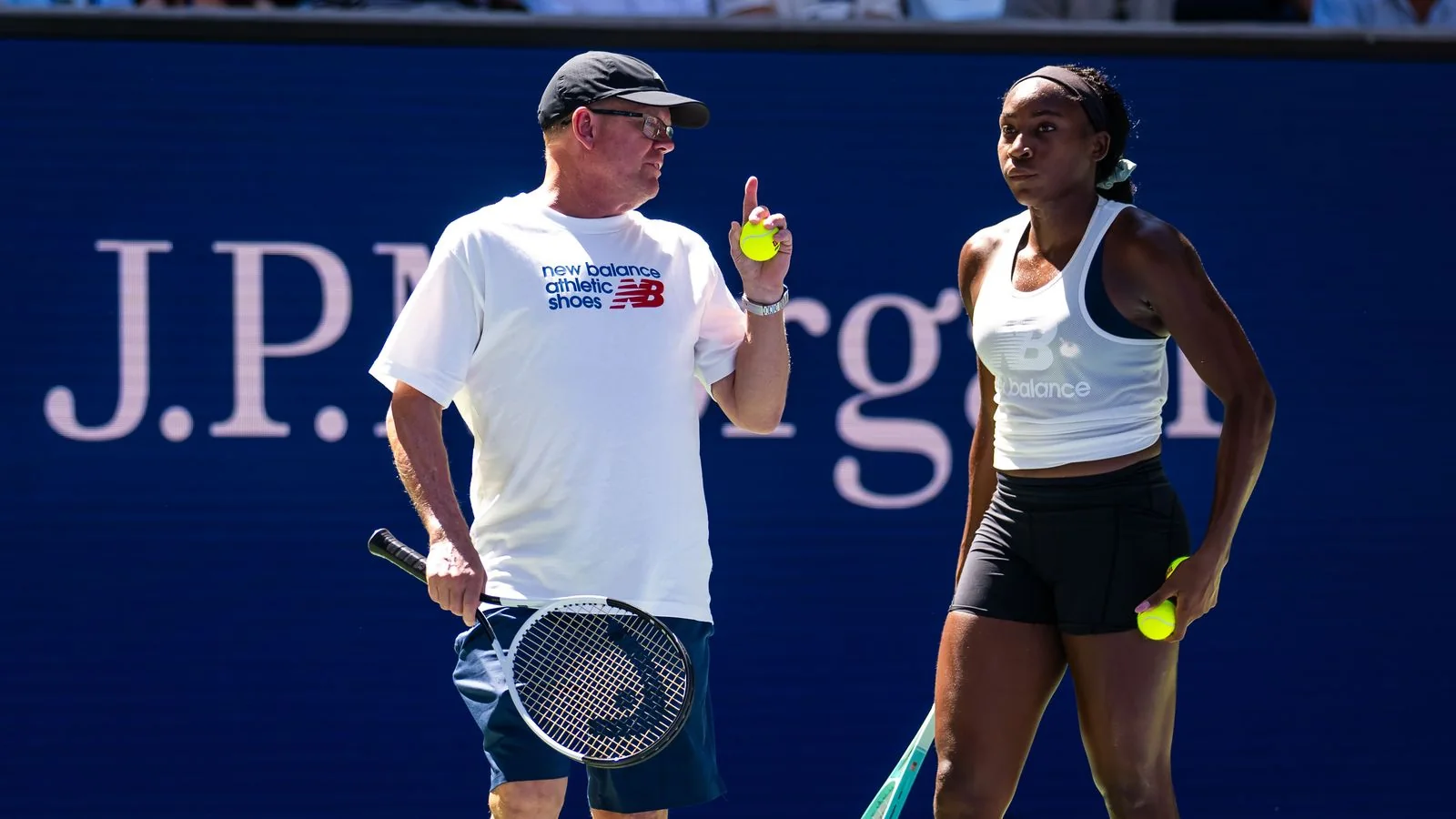
In August 2025, biomechanics specialist Gavin MacMillan joined as Daly departed. The WTA's August 25 report describes MacMillan working on Gauff's service motion alongside Faurel. Faurel remained involved; a report saying both previous coaches left would misdescribe that change.
The appointment followed a difficult stretch of serving, and Gauff presented it as a decision about the long-term development of her game. That is a more careful description than declaring a permanent cure after a practice session. A motion can feel promising in training before it becomes reliable across different match conditions.
A 2026 WTA feature ahead of the US Open revisited her serving work and the progress since hiring MacMillan the previous year. Her official player biography, checked October 12, 2026, lists Faurel as her coach. Together, the dated reports explain Faurel's continuing coaching role and MacMillan's specialist contribution without treating an old team list as timeless.
When assessing a coaching headline, check the date, who joined or left, and what responsibility the article actually describes. A primary coach, a technical specialist and a consultant may appear together. Counting names without distinguishing their roles makes a changing team look more contradictory than it is.
From teenage promise to an independent champion
Gauff's achievements after the 2023 US Open show why her story cannot stop with a childhood breakthrough or one coaching appointment. On June 9, 2024, she won her first Grand Slam doubles title with Katerina Siniakova. They beat Sara Errani and Jasmine Paolini 7–6(5), 6–3 in Paris, as recorded in the WTA's doubles final report. This added a partnership achievement to her singles success.
A different championship followed in Riyadh that November. Gauff defeated Zheng Qinwen 3–6, 6–4, 7–6(2) in the 2024 WTA Finals title match. USTA's November 9 report confirms the comeback victory and her first trophy at the season-ending event. The WTA Finals belong in their own category: prestigious tour championships, rather than a fifth Grand Slam.
On June 7, 2025, she returned to the Roland-Garros singles final and beat Aryna Sabalenka 6–7(5), 6–2, 6–4. The official championship account identifies this as her second Grand Slam singles title and contrasts it with her runner-up finish in 2022. The Paris doubles trophy in 2024 and singles trophy in 2025 tell separate parts of her development.
Reading her career through dated milestones
Born on March 13, 2004, Gauff was 22 when this guide was researched on October 12, 2026. In her May 2026 Roland-Garros interview, she explained that Coco was a nickname used by family and friends since childhood. Cori and Coco in older and newer results refer to the same athlete.
That interview also describes her wish to inspire girls in the way Venus and Serena inspired her, and her continuing interest in learning beyond tennis. These are the priorities of an adult player describing her own ambitions. Family support remains part of the account, while her decisions, competition and identity also deserve attention.
When revisiting a milestone, attach the date and competition to it, then look at the team working with her during that period. Doing this avoids giving every past achievement to a current coach or treating a junior title as a senior championship. It leaves room for both the people who helped her and the athlete who played the matches.
For the next match, move from biography to the daily WTA schedule. The current singles rankings show her latest position, while the WTA viewing guide helps find coverage for your region. Those tools follow the present; the dated milestones explain how her career reached this point.