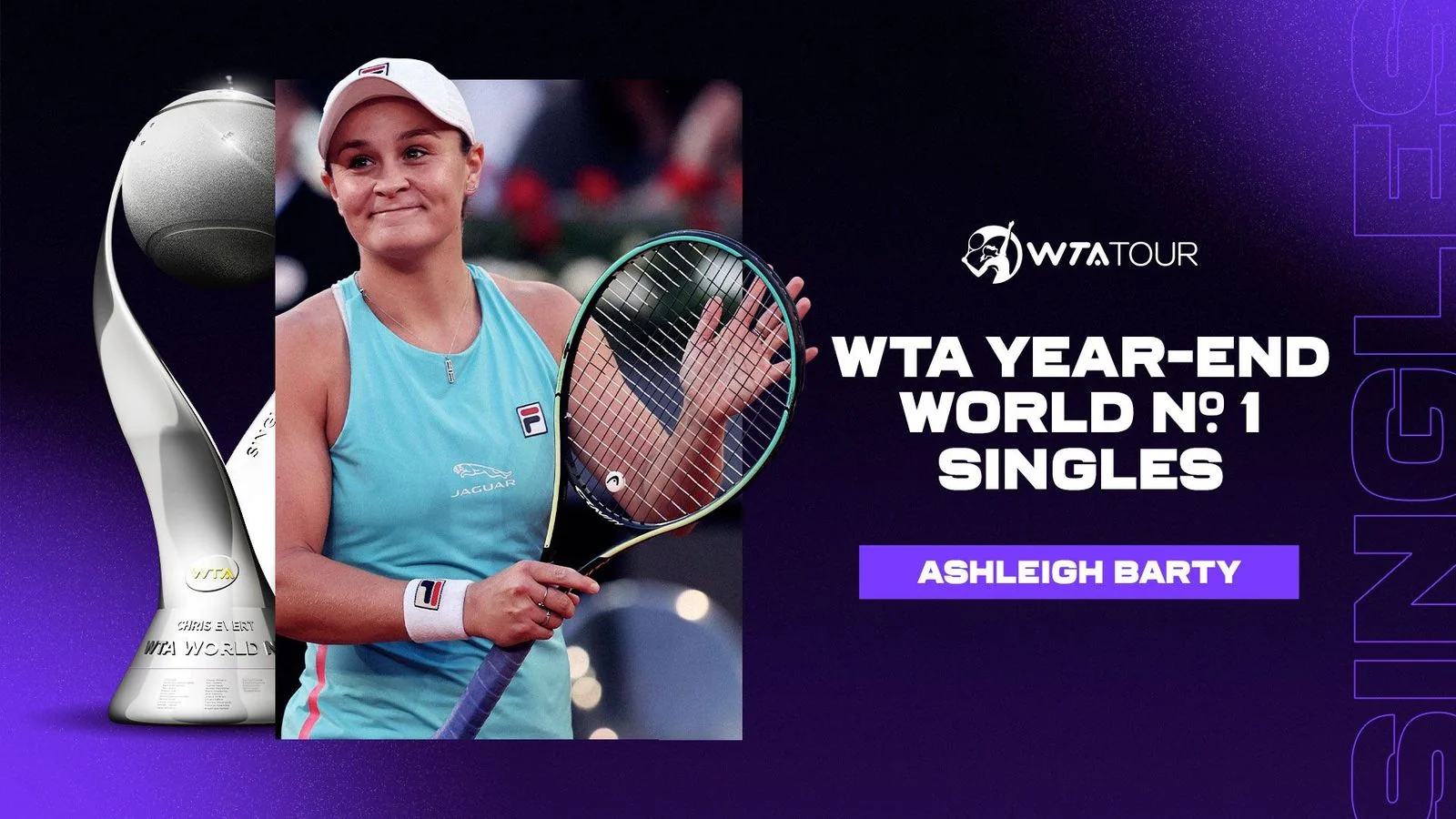
Ashleigh Barty finished 2021 as the WTA singles world No. 1 with 7,582 ranking points. Aryna Sabalenka was second and Garbiñe Muguruza third. The official year-end ranking uses November 15, 2021 as its date of record. Katerina Siniakova finished first in doubles.
The official 2021 year-end singles Top 10
The table is a historical season-end reference, not a live ranking. It gives each player's final singles position and ranking points. The WTA's official 2021 singles ranking archive provides the numeric list, while its season-end announcement confirms the order of the Top 10.
| Rank | Player | Ranking points |
|---|---|---|
| 1 | Ashleigh Barty | 7,582 |
| 2 | Aryna Sabalenka | 6,380 |
| 3 | Garbiñe Muguruza | 5,685 |
| 4 | Karolina Pliskova | 5,135 |
| 5 | Barbora Krejcikova | 5,008 |
| 6 | Maria Sakkari | 4,385 |
| 7 | Anett Kontaveit | 4,351 |
| 8 | Paula Badosa | 3,849 |
| 9 | Iga Swiatek | 3,786 |
| 10 | Ons Jabeur | 3,455 |
Which ranking date does the table use?
The WTA's November 18 year-end report explicitly identifies Monday, November 15 as the date of record. The linked PDF is printed November 17 and includes the Guadalajara WTA Finals among the most recently added events. Those dates describe different parts of publishing the ranking, rather than three different season-end tables.
Keep the official record date when citing a player's 2021 finish. A page dated December 31, a generic “2021 rankings” dropdown, or a weekly ranking published before the Finals may serve a different purpose. Adding the exact date makes a comparison repeatable and prevents a midseason position from being mistaken for the official year-end result.
The ranking position and its points total are also different fields. A gap of one position can represent a small or large difference in points. For example, Sakkari and Kontaveit were separated by 34 points in this table, while Barty led Sabalenka by 1,202. The rank tells you the order; the points show the size of the gap in that particular calculation.
Why Ashleigh Barty finished 2021 at No. 1
Barty's third consecutive year-end No. 1 finish followed a season with five singles titles and a 42–8 match record. She withdrew from the Guadalajara Finals, a fact recorded in the October qualification update. Her absence from the final tournament did not remove the ranking points she already held.
Five titles across three surfaces
Her titles came at the Yarra Valley Classic, Miami, Stuttgart, Wimbledon and Cincinnati. The WTA's 2021 season retrospective traces those victories. Melbourne, Miami and Cincinnati were hard-court events; Stuttgart supplied a clay title and Wimbledon a grass title. Madrid was a runner-up finish, not a sixth championship.
That spread helps explain the season more clearly than saying Barty simply won Wimbledon. Her ranking reflected results across several portions of the calendar. A major championship can provide a large contribution, but a season-end table combines eligible results rather than handing first place automatically to a particular Grand Slam winner.
The Wimbledon victory also belongs specifically to 2021. Barty's Australian Open singles title came in 2022, as her official career profile makes clear. When a career summary groups the two titles together, they should not both be used to explain her 2021 ranking. Her 2019 Roland Garros title is another separate season achievement.
Ranking points and the Race are different totals
The WTA's year-end No. 1 announcement gives Barty 6,411 points in the Porsche Race to the WTA Finals. The official year-end world-ranking archive gives her 7,582. These are two named measures, not competing versions of the same field.
The Race tracks the season's qualification competition. The world ranking applies the ranking system in force to determine a player's position. In 2021, when pandemic-era ranking adjustments still mattered, treating the two as interchangeable is particularly misleading. Label the total you are using before comparing it with another player.
Subtracting 6,411 from 7,582 gives 1,171, but that arithmetic does not identify the events responsible for the difference. Reconstructing each retained result would require her dated ranking breakdown and the applicable policy. For a straightforward historical lookup, report the official 7,582 ranking total and keep the Race figure clearly separate.
What the WTA Finals changed in the final standings
The 2021 WTA Finals were held in Guadalajara, Mexico. Muguruza won the championship against Kontaveit 6–3, 7–5 in the local Wednesday final on November 17. The WTA's report published November 18 identifies Muguruza as the first Spanish singles champion in the event's history.
The title helped Muguruza finish the year third. Kontaveit's runner-up campaign brought her to seventh. The ranking archive's points-added column lists 1,375 for Muguruza and 955 for Kontaveit. Those are the documented 2021 event awards; a points table from a later Finals edition should not be used to recalculate this tournament.
Muguruza's title and Kontaveit's late surge
Kontaveit's finish followed four late-season titles in Cleveland, Ostrava, Moscow and Cluj-Napoca. Her 6–2, 6–3 victory over Simona Halep in Cluj secured the last available Finals place, as the October 31 championship report explains. The year-end ranking therefore captures the endpoint of a substantial late run, rather than the level she occupied throughout every month of 2021.
Muguruza and Kontaveit met twice in Guadalajara: once in the group phase and again for the title. Muguruza won both encounters. Their final positions in the world ranking were not their tournament seeds: Muguruza was seeded sixth and Kontaveit eighth at the Finals, before finishing the season third and seventh respectively.
This is also why a champion photo cannot substitute for the ranking table. Muguruza earned the event trophy, while Barty remained the season-end leader. A fan asking who was “best at the Finals” and a fan asking who was “No. 1 in 2021” are asking different, equally answerable questions.
For season comparisons, note the whole path. Kontaveit's autumn titles explain how she reached the event; her Guadalajara results explain the final contribution. Looking only at the final loss would hide much of the improvement that made her seventh-place finish possible.
The breakthroughs behind the 2021 rankings
A year-end list is more revealing when the numbers sit beside the results that produced them. In 2021, players arrived at prominent positions through very different seasons: an established doubles specialist built a singles breakthrough, two teenagers contested a major final, and another teenager added success on clay.
Krejcikova's rise in singles and doubles
Krejcikova ended 2021 at No. 5 in singles and No. 2 in doubles. Her official career history lists three singles titles that season: Strasbourg, Roland Garros and Prague. The titles came on both clay and hard courts, so her final singles position was not built entirely on one Paris fortnight.
At Roland Garros, she defeated Anastasia Pavlyuchenkova 6–1, 2–6, 6–4 in the singles final. The June 12 match report records that this was only her fifth Grand Slam singles main draw. She also won the women's doubles title with Siniakova during the same tournament.
Her two year-end numbers belong to separate competitions. No. 5 did not incorporate doubles points, and No. 2 did not incorporate her singles title. Fans following both draws can celebrate the combined achievement while keeping each ranking calculation separate.
Raducanu, Fernandez and Gauff outside the Top 10
| Player | 2021 year-end singles rank | Season result to remember |
|---|---|---|
| Emma Raducanu | 19 | US Open champion |
| Coco Gauff | 22 | Parma singles champion |
| Leylah Fernandez | 24 | US Open finalist |
Raducanu beat Fernandez 6–4, 6–3 in the US Open final after coming through qualifying. Her title and Fernandez's runner-up finish were extraordinary achievements, but neither player finished inside the year-end Top 10. Winning a particular major and collecting enough counted points for a particular season-end position are different accomplishments.
Gauff's 2021 included a singles and doubles sweep in Parma. She defeated Wang Qiang 6–1, 6–3 in the singles final and partnered Caty McNally for the doubles trophy. Her No. 22 singles finish offers another useful reminder: a successful development season does not have to end in the first ten rows to matter.
When revisiting these players' 2021 seasons, use these historical positions rather than their later career highs. Subsequent success cannot be inserted retroactively into a ranking table from November 2021.
The 2021 year-end doubles leaders
Katerina Siniakova finished 2021 as the doubles world No. 1, with Barbora Krejcikova at No. 2. The official November 18 announcement confirms Siniakova's award. This is the doubles answer to the year-end No. 1 question; Barty's award covered singles.
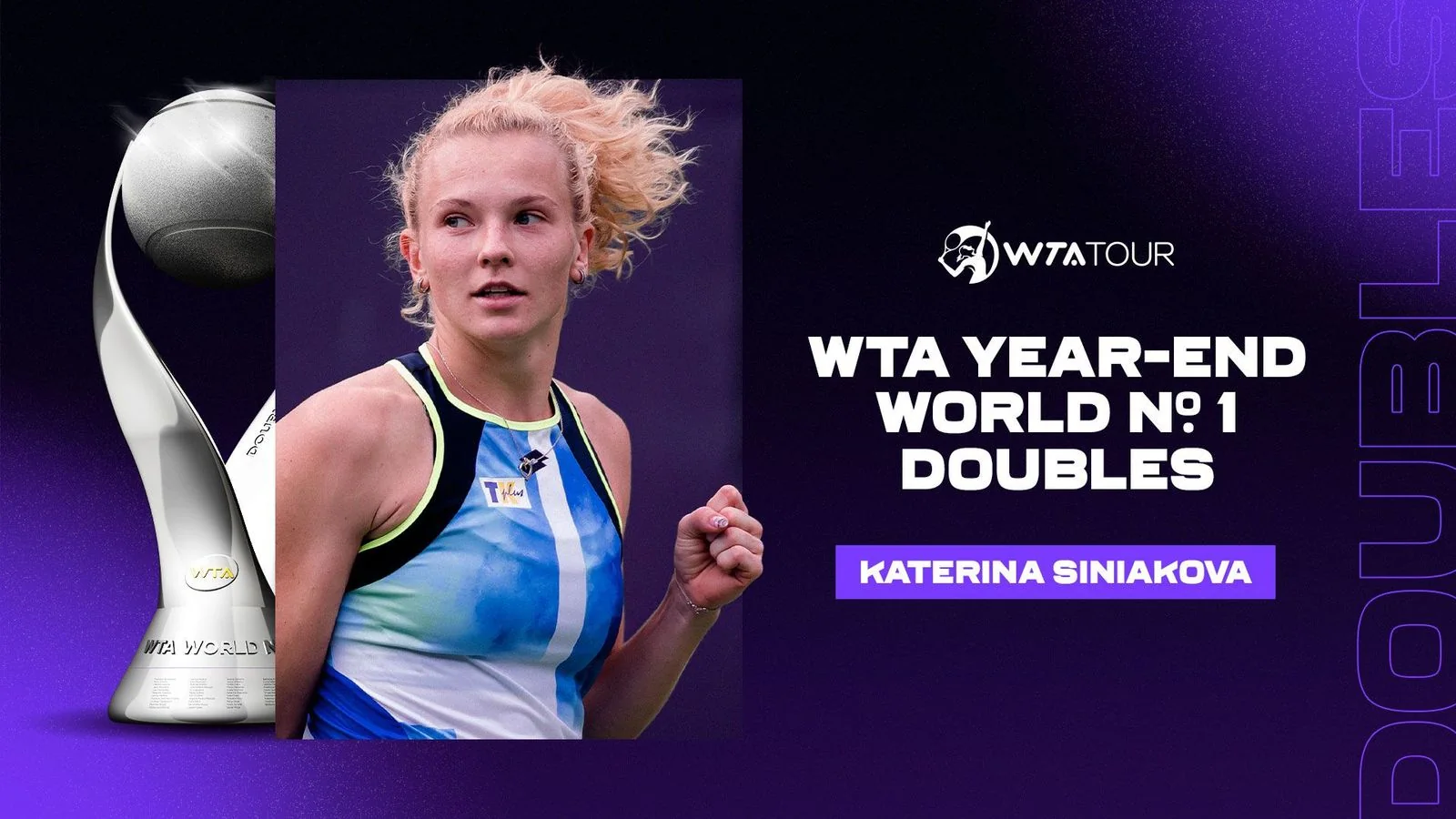
Krejcikova and Siniakova won the Guadalajara Finals together, beating Hsieh Su-wei and Elise Mertens 6–3, 6–4. The official final scorecard identifies the match and the November 17 date. That event result belongs to the partnership, even though the year-end individual ranking gave the two players different positions.
Siniakova and Krejcikova had different individual rankings
A doubles ranking row names a player, not a permanent team. Partners share results when they compete together, but they may also enter other tournaments with someone else. Consequently, it is entirely possible for the members of a successful regular partnership to hold different individual ranks.
Siniakova's Moscow title supplies a concrete 2021 example. She partnered Jelena Ostapenko there, winning the final against Nadiia Kichenok and Raluca Olaru 6–2, 4–6, [10–8]. The Kremlin Cup championship report includes that doubles result. It was not a Krejcikova–Siniakova team victory.
The Czech pair also won Olympic gold in Tokyo during 2021. That achievement belongs in a season recap, but medals and ranking points are different records. An award announcement listing trophies does not, by itself, establish how many ranking points each competition supplied.
For a fan checking a doubles draw, keep the pair's names and the individual ranking date together. For a fan looking up who ended 2021 first, Siniakova is the answer. The current doubles rankings show a different date and should be used for today's standings rather than as a replacement for this historical result.
Why 2021 ranking totals need historical context
The 2021 rankings were official, but their calculation occurred during a transition out of the pandemic's disruption. The WTA's March 25 policy announcement introduced changes from April 5, following Miami. Different tournament circumstances required different rules for how long results remained eligible.
Pandemic adjustments and the return toward 52 weeks
The September 4 update set March 2022 as the target for returning to the traditional 52-week model at tour level. It explicitly stated that the 2021 year-end ranking would not include 2019 points from WTA 250 events and higher.
That statement had limits. The announcement treated the 2019 offseason WTA 125 events in Houston, Taipei and Limoges separately, allowing their results to remain for the full 104 weeks. It also specified the expiry process for early-season results counted under the better-of-2020/2021 system. A blanket claim that every player's November total contained only results earned in calendar 2021 would therefore be inaccurate.
The lower tiers had their own adjustments. The ITF's April 9 release described temporary increases in points at selected women's World Tennis Tour categories, alongside changes to retention of earlier ITF results. A tour-level rule should not automatically be extended to every event contributing to a player farther down the ranking.
For practical reading, separate three things: when the ranking was published, when each contributing result occurred, and which policy governed its expiry. A 2021 publication date does not establish that every counted result was played that year. Equally, the existence of retained points does not invalidate the official ranking; it explains the system under which the ranking was produced.
These details also limit comparisons with other seasons. Dividing Barty's total by another year's No. 1 total would produce a number, but not a clean measurement of relative playing strength. Calendars, eligible results and points rules need to be comparable before such a comparison can carry much meaning.
If you want to reconstruct a player's exact total, use the dated individual breakdown and contemporaneous policy. Neither a modern ranking explainer nor a men's ATP pandemic summary is a substitute for the WTA rules that applied to the selected 2021 week.
How to read a 2021 ranking archive today
Start with the question you want the archive to answer. “Where did a player finish 2021?” calls for the official year-end table. “What was her ranking before Wimbledon?” needs the relevant earlier weekly list. “How high did she climb that year?” needs the highest position reached during the season, which can differ from the finishing position.
Jabeur provides a simple example. She ended 2021 tenth, although she had reached seventh on November 1, as the official season-end review records. Both numbers describe real rankings; they answer different date-based questions. Neither should silently replace the other in a retrospective table.
- Confirm the discipline. Select singles or doubles before comparing players. A doubles position cannot be inserted into a singles table.
- Read the date and the table label. Check whether the page is a weekly ranking, an official year-end archive or a Race leaderboard. Save the date alongside the number if you are making a season comparison.
- Match the player name. An archive may use accents or a full given name that differs from the familiar broadcast name. Check the player rather than assuming a spelling variation represents someone else.
- Keep points and positions together. A player's rank describes her place relative to others on that list; her points describe the eligible total used for it. A tournament seed is a separate draw designation.
- Use the applicable season's rules. For 2021, retain the pandemic-transition context before trying to reproduce a points total.
For present-day questions, move to the current WTA singles rankings or current doubles rankings. If your next question is when a player takes the court, the WTA matches today page serves that purpose. Those tools follow current competition; this article preserves a specific historical season.
The useful habit is to cite a position with its date and scope: for example, “Barty, 2021 year-end singles No. 1.” That short label preserves the meaning of the fact when it is shared, compared with another season, or read beside a much newer player profile.