The 2023 WTA year-end top 10
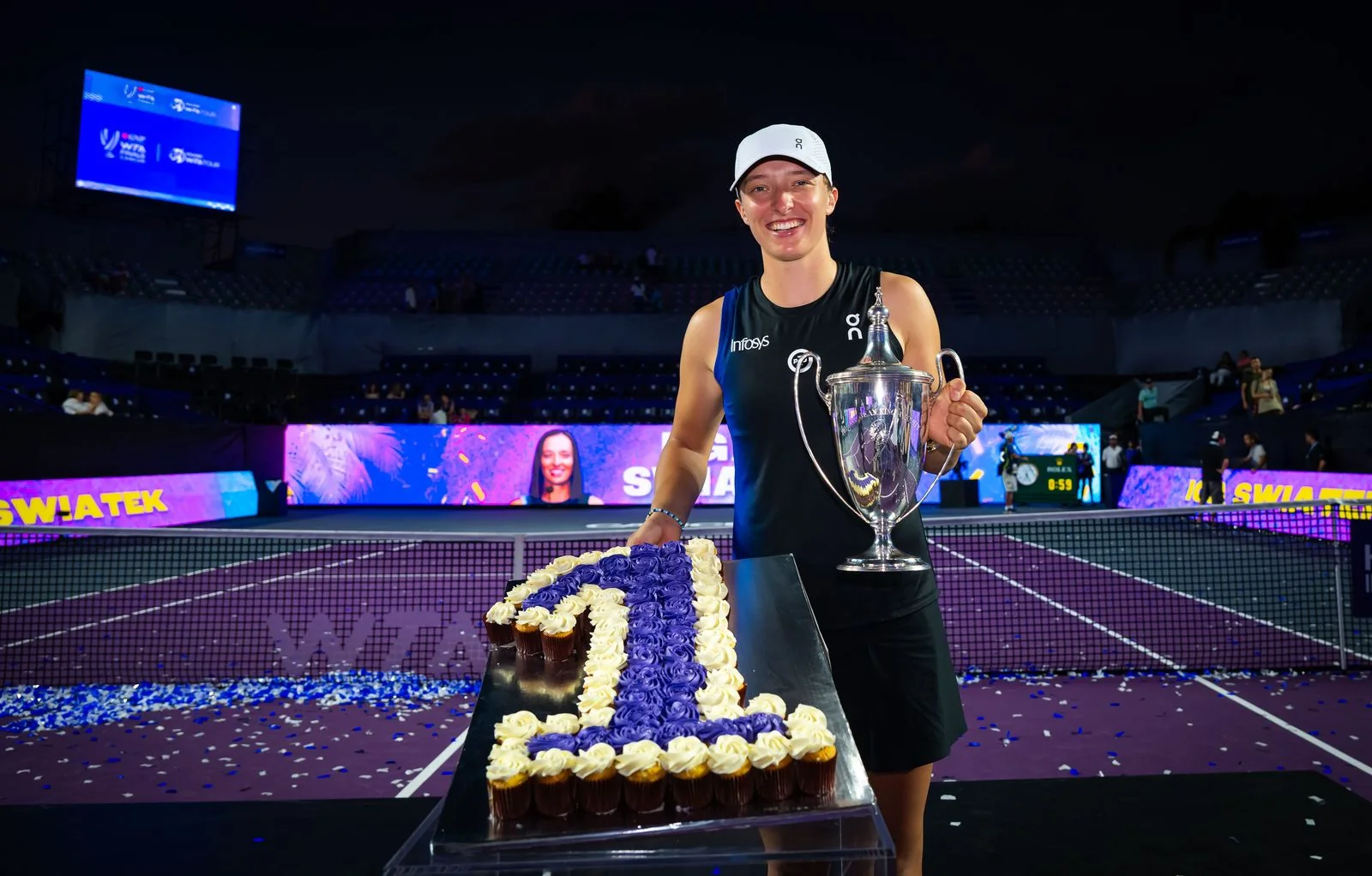
The 2023 WTA year-end No. 1 was Iga Swiatek. Aryna Sabalenka finished second and Coco Gauff third. Swiatek ended with 9,295 ranking points, a 245-point lead over Sabalenka. These are historical singles positions from the completed 2023 season.
| Year-end rank | Player | Points |
|---|---|---|
| 1 | Iga Swiatek | 9,295 |
| 2 | Aryna Sabalenka | 9,050 |
| 3 | Coco Gauff | 6,580 |
| 4 | Elena Rybakina | 6,365 |
| 5 | Jessica Pegula | 5,975 |
| 6 | Ons Jabeur | 4,195 |
| 7 | Marketa Vondrousova | 4,046 |
| 8 | Karolina Muchova | 3,650 |
| 9 | Maria Sakkari | 3,620 |
| 10 | Barbora Krejcikova | 2,880 |
The WTA's November 7 season review identifies this top ten after the Cancun Finals. The tour's historical record book retains their points. Later rankings, including the current list, answer a different question: a player's place today cannot be substituted for her finish in 2023.
Points make the table more useful than positions alone. Gauff finished one place behind Sabalenka, with a 2,470-point gap. Muchova was also one place ahead of Sakkari, but their difference was only 30 points. Adjacent ranking numbers can describe very different distances in the points standings.
The season's main ranking story was a late reversal at the top. Sabalenka had become No. 1 after the US Open; Swiatek recovered the year-end lead through the final championship. The sections below explain that finish, the major winners and the separate doubles leader. If you need seedings for an upcoming event, go to the current WTA rankings and check the date used by that tournament.
How Swiatek reclaimed No. 1 from Sabalenka
Two dates shape the story of the 2023 leaders: the change after New York and the final championship in Cancun. Sabalenka led the rankings during the autumn. Swiatek finished the season first. Both statements describe real parts of the same year, so a historical No. 1 claim always needs its date.
The change after the US Open
Jelena Ostapenko ended Swiatek's US Open defense in the fourth round, winning 3-6, 6-3, 6-1. The defeat meant Sabalenka would take over at No. 1 after the event. Her spell at the top lasted eight weeks in 2023.
Rankings compare retained results as well as newly earned points. A defending champion can win several rounds and still lose ground against her previous total if she exits before the final. The question is therefore larger than whether a player won her latest match: the earlier points falling out of the calculation matter too.
The decisive finish in Cancun
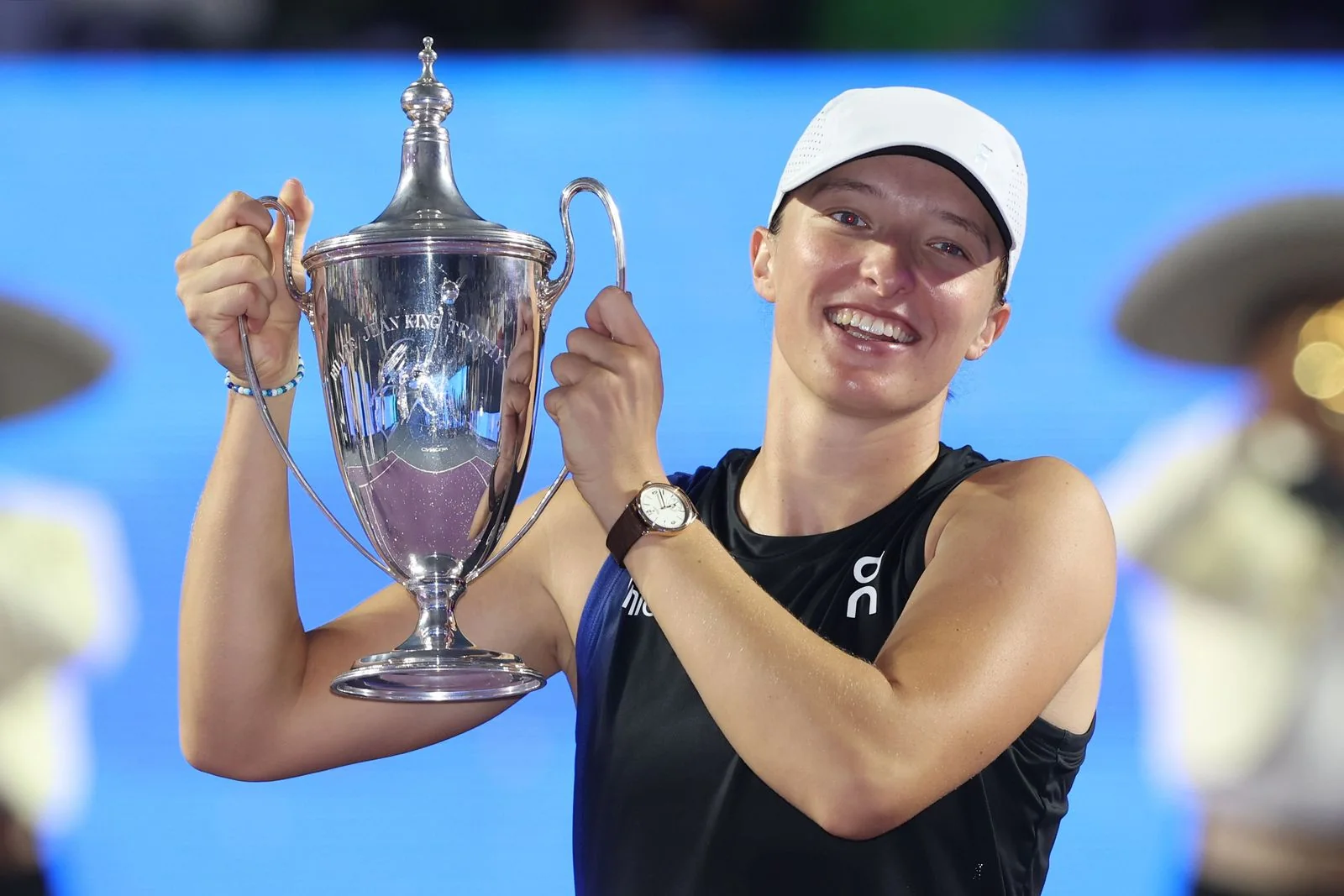
Before the Finals, the official No. 1 scenarios gave Sabalenka a 630-point lead in the Race. Swiatek beat her in the semifinal, then beat Jessica Pegula 6-1, 6-0 in the final on November 6. The title secured Swiatek's season-ending return to first place.
The distinction between those two wins is important. Eliminating Sabalenka kept Swiatek's chance alive; she still needed the final result. Old previews discuss what would happen under different combinations of wins. They cannot replace the completed final report when you want to know who actually finished No. 1.
A useful way to review the contest is to keep three separate entries: the leader before Cancun, the players' results in Cancun and the final points. The eventual 245-point margin comes from the last of those. It is not a match score, a head-to-head tally or a bonus handed to Swiatek simply for defeating a higher-ranked opponent.
What the Grand Slam results explain
The four major champions offer a quick route into the season, especially if you followed only the biggest tournaments. All four finished in the top seven. Their order on the year-end list, however, was not simply the order in which they lifted trophies.
Four champions across four majors
Australian Open: Sabalenka beat Rybakina 4-6, 6-3, 6-4 to win her first major singles title. Melbourne established an early benchmark in their rivalry. The official Australian Open final report also makes the immediate ranking context clear: the victory returned Sabalenka to No. 2, rather than making her No. 1 in January.
Roland Garros: Swiatek defeated Muchova 6-2, 5-7, 6-4. It was a three-set final, with the eventual year-end leader needing the deciding set against a player who would finish eighth. The WTA's Paris report records Swiatek's third French Open title.
Wimbledon: Vondrousova beat Jabeur 6-4, 6-4 to claim her first major title. For an archive search, that is the 2023 women's singles final: Vondrousova was the champion and Jabeur the runner-up. The official final account provides the match context.
US Open: Gauff came back from a set down to beat Sabalenka 2-6, 6-3, 6-2 for her first major. New York therefore produced two different milestones: a title for Gauff and the ranking change for Sabalenka. The completed final report settles the champion's identity.
Why a major title does not settle the rankings
A championship list answers who won those four tournaments. The ranking table combines a wider body of results. You cannot calculate year-end order by counting major titles alone: Swiatek, Sabalenka, Gauff and Vondrousova each won one, yet finished first, second, third and seventh respectively.
For a fan comparing two players, that difference suggests a better question: how did each perform across the calendar, including the weeks between majors? A finalist can collect important results without winning the trophy, while a champion's other events still affect her total. Rankings offer season context; a final score tells you what happened in one contest.
Keep the dates aligned when watching an old match. A seed shown in a 2023 draw describes the ordering used for that event. A November year-end position describes where the player finished later. Replacing one with the other can make a perfectly accurate old scorecard appear inconsistent.
The leading doubles player was Storm Hunter
Storm Hunter finished 2023 as the WTA doubles No. 1. Her season included titles in Rome and Guadalajara with Elise Mertens, plus a Wimbledon final with the same partner. Her official WTA career record identifies those results and the year-end ranking.
This is an individual doubles position. It does not mean Hunter and Mertens won every major doubles event or that Hunter led the singles list. One player can have a different partner at different tournaments, and her personal ranking remains distinct from the name of a team in a draw.
The Cancun champions illustrate the difference particularly well. Laura Siegemund and Vera Zvonareva won the 2023 WTA Finals doubles title, defeating Nicole Melichar-Martinez and Ellen Perez 6-4, 6-4 in the final. The official doubles final report names that winning partnership. Hunter's season-ending ranking and their championship belong in separate columns.
When you look up an old doubles result, search both surnames and the tournament year. Searching only one player can bring back singles results, another partnership or mixed doubles. The score identifies the match; the pair of names identifies the team. Neither alone establishes a player's final position on the doubles rankings.
For following the sport now, use the current WTA doubles rankings alongside the event draw. The ranking list helps you recognize the players, while the draw tells you who is competing together that week. A singles ranking page cannot supply that information.
The same distinction matters when reading a season recap. “Year-end No. 1,” “WTA Finals champion” and “Grand Slam champion” are different achievements. A precise recap names the discipline and, for a team title, both partners. That lets you compare like with like without overlooking a doubles specialist's season.
New top-10 faces and important returns
A final position is only one way to describe a season. Improvement compares that position with an earlier starting point. The two measures help explain why a player outside the first ten can still be one of the year's most interesting stories.
Vondrousova and Muchova
Muchova moved from No. 149 at the end of 2022 to No. 8 in 2023; Vondrousova went from No. 99 to No. 7. Both recorded their first year-end top-ten finishes, as did Rybakina. Those changes are documented in the WTA's year-end ranking review.
Their major results give those numbers a recognizable setting. Vondrousova won Wimbledon, while Muchova reached the Roland Garros final. For a viewer returning to tennis after a season away, they are useful names to connect with the 2023 rankings rather than treating the table as ten isolated numbers.
The scale of an improvement also depends on the starting position. A rise from 149 to eight spans 141 places; a rise from 99 to seven spans 92. Those are arithmetic comparisons of positions, not an extra points award. They describe movement through the field and should not be used as a substitute for the final points total.
Looking beyond the first ten names
Mirra Andreeva finished No. 46 after ending the previous year at No. 405. The WTA named her its 2023 Newcomer of the Year. Elina Svitolina, who returned to competition in April, finished No. 25 and received the Comeback Player of the Year award. Her return included a Strasbourg title, a Roland Garros quarterfinal and a Wimbledon semifinal. The official December awards announcement records those distinctions.
Awards and ranking positions answer different questions. The player awards reflect a vote by international tennis media; the ranking is a points table. Being chosen as the leading newcomer does not make Andreeva the highest-ranked player overall. Likewise, a comeback award recognizes a return to competition rather than changing a player's position on the list.
When revisiting the season, start with the top ten to understand its leading group, then follow the players whose stories interest you. A comeback, a first major run or a large rise can be meaningful without ending at No. 1. Keeping those descriptions precise gives a fuller picture of 2023 without stretching what the rankings themselves establish.
How to interpret a year-end ranking
The year-end table is a historical snapshot, not a running count of wins. It gives an overall position at a defined point in the season. A match record, a title count and a head-to-head record each describe something else, even when all four are useful for discussing a player.
The 2023 WTA rulebook defined singles rankings using sixteen tournament results over a rolling 52-week period, subject to required events and other conditions. It was not simply permission to choose any sixteen results. Use the historical rulebook when explaining that season; a current points guide may describe a later system.
Rankings, the Race and a player's peak
The weekly ranking follows the rolling calculation. The Race tracks eligible results from the current calendar year for Finals qualification. Under the 2023 rules, ITF and WTA 125 results were replaced by the next-best eligible tour results in the singles Race calculation. A career-high ranking describes the highest position a player reached at some point, not necessarily her position at the end of a particular season.
That is why the label above a table matters as much as its numbers. A Race preview before Cancun describes the qualification or No. 1 contest at that stage. A completed year-end table describes the outcome after the final championship. A career-high badge can refer to an entirely different month or year.
Points can move down even after a good week. As a simple illustration, suppose an old counted result of 500 points expires and a new counted result supplies 300, with everything else unchanged. The total falls by 200. This is an example of the arithmetic, not a reconstruction of any player's 2023 ranking. Actual calculations also depend on which results count.
For practical comparisons, record the discipline, the ranking date and the points alongside the position. If two screenshots disagree, check those fields first. One may show singles and another doubles, or one may be a pre-Finals Race table. A different date or calculation can explain the apparent contradiction without either screenshot being wrong.
Use the WTA calendar to follow the sequence of tournaments when reviewing a season. It helps place a ranking update after the event that changed it. The final table remains the appropriate starting point for “Who finished 2023 where?”; the dated weekly lists are better for “Who led during this tournament?”
Finding the right historical ranking
For the official 2023 year-end top ten, use the WTA's dated November 7 season review and the historical year-end tables in its record book. For a particular Monday in 2023, look for a weekly list bearing that exact date. Those are different archive requests.
“Year-end” does not automatically mean the last Monday in December. The WTA recognized the season-ending rankings after Cancun, while further tennis remained on the schedule. Its November 7 weekly review noted that WTA 125 events would continue over the following five weeks. A later ordinary ranking update should not silently replace the recognized year-end list in a historical comparison.
An old article can also link to a file that is updated in place. Before treating a PDF as historical evidence, check its printed ranking date. If it displays a later season, follow the archive or record book instead. The age of the article linking to it does not guarantee the age of the file you open.
- Who finished No. 1 in 2023? Swiatek in singles; Hunter in doubles.
- Who was No. 1 during the US Open? Use the tournament's dated ranking context and the update after the event, rather than the final table.
- Who won the 2023 WTA Finals? Swiatek in singles; Siegemund and Zvonareva in doubles.
- Where is a player ranked now? Use the current ranking list and its displayed date.
For a match archive, combine the player's name with the event, round and year. This narrows a search much more effectively than a name plus “ranking.” A match report can tell you why the result mattered at that moment; the year-end table then tells you where the wider season finished.
If the historical season has led you back to following today's tour, check today's WTA matches for the next contest and the current rankings for present positions. Keep the 2023 table as the reference for that completed season. It preserves the late Swiatek–Sabalenka contest, Gauff's third-place finish and the wider group as they stood at the season's close.