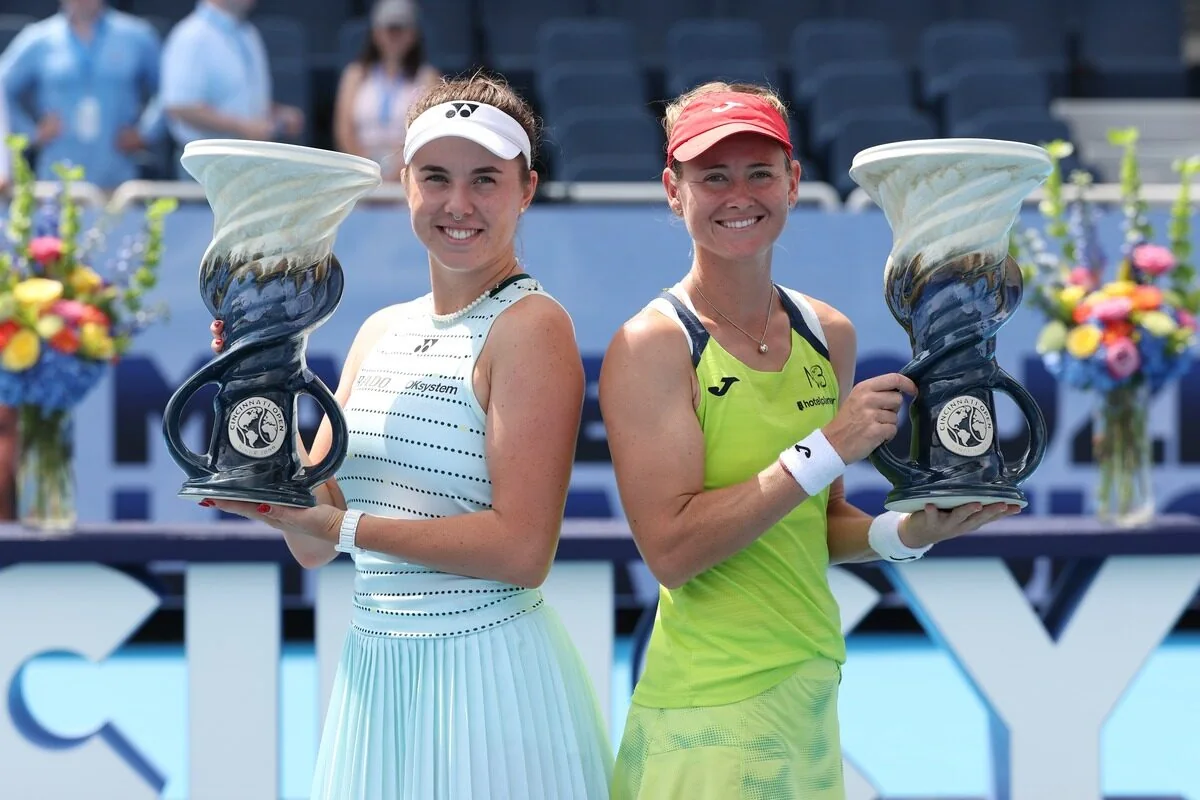
Marie Bouzkova and Linda Noskova won the 2026 Cincinnati Open women’s doubles title. The Czech pair defeated Magali Kempen and Alexandra Panova 6-1, 6-2 in the Saturday, August 22 final, completing the championship match in exactly one hour.
This page covers the completed WTA women’s doubles draw only. It does not combine the ATP men’s doubles event, mixed doubles or either singles bracket. Scores are final, while links to current match tools are included only for readers following later tournaments.
Champions
Bouzkova / Noskova
Final score
6-1, 6-2
Final duration
1:00
Cincinnati 2026 women’s doubles result at a glance
The championship was the first title Bouzkova and Noskova won as a team. They entered unseeded and beat the unseeded combination of Kempen and Panova in the final. The straight-set score was their clearest result of the week, and the official recaps describe an early break in each set before the champions separated further.
| Final fact | Completed result |
|---|---|
| Date | Saturday, August 22, 2026 |
| Champions | Marie Bouzkova / Linda Noskova |
| Runners-up | Magali Kempen / Alexandra Panova |
| Score | 6-1, 6-2 |
| Venue/surface | Lindner Family Tennis Center, outdoor hard court |
Individually, the title was Bouzkova’s seventh at tour level in doubles and Noskova’s second. Team title counts and individual title counts answer different questions: “first together” does not mean either woman had never won doubles before. The 2026 Cincinnati tournament page provides the event-level schedule context.
Bouzkova and Noskova’s route through the draw
The champions played five matches, the full path required in a 32-team knockout draw. Four ended in straight sets. Their only deciding match tiebreak came in the round of 16 against Gabriela Dabrowski and Barbora Krejcikova, after the teams split the first two sets.
| Round | Opponents | Bouzkova/Noskova result |
|---|---|---|
| Round of 32 | Caroline Dolehide / Emma Navarro | 6-4, 6-4 |
| Round of 16 | Gabriela Dabrowski / Barbora Krejcikova | 6-3, 1-6, [10-7] |
| Quarterfinal | Erin Routliffe / Aldila Sutjiadi (7) | 7-5, 7-5 |
| Semifinal | Iva Jovic / Caty McNally | 6-3, 6-2 |
| Final | Magali Kempen / Alexandra Panova | 6-1, 6-2 |
The bracket grew cleaner after the round-of-16 escape. Routliffe and Sutjiadi, the No. 7 seeds, pushed both quarterfinal sets to 5-5 before the Czech pair closed each 7-5. The semifinal and final then produced progressively wider margins: five games conceded to Jovic and McNally, followed by three in the title match.
The `[10-7]` notation is important. Doubles uses a match tiebreak in place of a conventional third set under this format. Bouzkova and Noskova did not win a full third set 10 games to seven. They reached 10 points first in the deciding match tiebreak after a 6-3, 1-6 split.
Their route also crossed different team profiles: two American singles players, two accomplished major doubles champions, a seeded specialist pairing, a young/home-interest American combination and an unseeded finalist team. That variety supports the WTA recap’s description of complementary skills without requiring a claim that every round was equally difficult.
For the complete bracket around these five lines, use the related WTA Cincinnati draw guide. A route table summarizes the champions; it does not replace the other 27 first-round teams.
How the doubles final was decided
Bouzkova and Noskova established scoreboard pressure early in both sets. The tournament recap identifies the first break for a 3-1 lead in the opener. They broke early again in the second and continued to separate. By the end, the WTA reported five breaks for the champions and a double-break margin in each set.
That pattern matters in doubles because serve can protect a team from having to chase at the net and on return. Kempen and Panova rarely had the chance to settle into a long stretch of level service games. The 6-1 first set placed them immediately under match pressure; the early second-set break removed the prospect of a clean restart.
Scoreboard pattern
Early break in set one, early break in set two, five breaks overall and a one-hour finish.
Partnership pattern
The champions described Noskova supplying power and improving at net, with Bouzkova covering space and staying active.
The partnership explanation came from the players rather than an invented tactical chart. Bouzkova described a split of responsibilities: Noskova’s power and progress on the volley complemented Bouzkova’s effort to cover available space and remain active. The score supports a team finding effective roles, but the opened reports do not publish enough shot-level data to assign every break to one player.
Straight-set finals can still contain isolated resistance, yet the responsible recap must follow the verified frame. There is no official basis here for adding ace counts, winner totals or net-point percentages. What is known is sufficient: Bouzkova and Noskova repeatedly broke serve, conceded only three games and never allowed the final to reach a deciding match tiebreak.
For Kempen and Panova, the loss does not negate the run. Their difficulty in this one-hour final was specific to a champion team performing at its best level of the week, according to Noskova. The next section separates that final score from the four victories that made the runners-up’ Cincinnati appearance significant.
Kempen and Panova’s runner-up run
Kempen and Panova reached Cincinnati in only their sixth tournament as a partnership. They had begun playing together in late June, progressed from an early Bad Homburg loss to the Iasi semifinals and Hamburg final, then produced their biggest run in Mason. The path included victories over the No. 2 and No. 5 seeds.
| Round | Opponents | Kempen/Panova result |
|---|---|---|
| Round of 32 | Storm Hunter / Desirae Krawczyk | 6-3, 6-4 |
| Round of 16 | Anna Danilina / Aleksandra Krunic (2) | 6-3, 6-2 |
| Quarterfinal | Latisha Chan / Maya Joint | 1-6, 6-4, [10-2] |
| Semifinal | Hsieh Su-wei / Jelena Ostapenko (5) | 6-3, 7-5 |
| Final | Marie Bouzkova / Linda Noskova | 1-6, 2-6 |
The quarterfinal was their sharpest reversal. Chan and Joint took the first set 6-1. Kempen and Panova answered 6-4 and then dominated the deciding match tiebreak 10-2. The next day they removed the last seeded pair in their half, beating Hsieh and Ostapenko in two sets.
Those two seeded wins deserve context. Danilina and Krunic had reached major finals together during the season, while Hsieh and Ostapenko carried extensive top-level doubles experience. Beating both does not make Kempen and Panova the eventual champions, but it explains why the final represented more than a favorable bracket.
The WTA feature emphasized communication, complementary game styles and trust as the pair’s explanation for rapid progress. That account is more reliable than retrofitting a tactical theory from scorelines alone. A partnership only weeks old had learned enough shared patterns to recover from a 1-6 set and defeat two seeded teams.
Their final loss was clear, yet “runner-up” remains an earned result: four match wins, a second tour final of 2026 together and a first WTA 1000 final as a pair. That is the appropriate record to carry forward, without converting near success into a title they did not win.
Notable teams and turning points in the draw
The Williams sisters brought the most recognizable entry storyline. Serena and Venus accepted a wild card for their first tournament together since the 2022 US Open. Their shared record—14 major doubles titles and three Olympic gold medals—explained the attention, but the 2026 draw still began at zero. Marta Kostyuk and Peyton Stearns beat them 6-2, 1-6, [10-8] in the opening round.
That result illustrates the compressed pressure of a match tiebreak. The sisters responded strongly after losing the first set, yet the deciding race ended with a two-point margin. A headline saying only “Williams lost in three” misses the format: the third component was a first-to-10 match tiebreak, not a conventional six-game set.
Jovic and McNally remove the top seeds
The American pair beat No. 1 Katerina Siniakova and Taylor Townsend 5-7, 6-4, [10-8], then eliminated No. 6 Jiang Xinyu and Zhang Shuai 7-6(8), 3-6, [10-6]. Their run ended against Bouzkova and Noskova in the semifinals.
Only one seeded semifinal team
No. 5 Hsieh Su-wei and Jelena Ostapenko were the only seeds in the last four. Kempen and Panova beat them 6-3, 7-5, leaving two unseeded teams to contest the final.
The draw’s turning points were therefore not confined to one upset. The No. 1, No. 2, No. 5, No. 6 and No. 7 teams all lost before the final, with several exits decided by match tiebreaks. Seeds still signal ranking-based expectations, but they do not carry byes or guaranteed advancement through a 32-team doubles bracket.
A results archive should resist ranking these stories by fame. The Williams reunion was historically notable; Jovic and McNally produced two seeded upsets; Hsieh and Ostapenko went deepest among seeds; Bouzkova/Noskova and Kempen/Panova won the matches required to reach the final. Each claim answers a different part of the completed draw.
Women’s doubles schedule and format explained
Cincinnati’s women’s doubles competition occupied the final seven days of the event window. The first round was scheduled across August 16-17, followed by two days for the round of 16. From the quarterfinals onward, each stage had one calendar date, with the championship on Saturday rather than the Sunday used for singles finals.
| Round | 2026 date | Teams remaining after round |
|---|---|---|
| Round of 32 | August 16-17 | 16 |
| Round of 16 | August 18-19 | 8 |
| Quarterfinals | August 20 | 4 |
| Semifinals | August 21 | 2 |
| Final | August 22 | 1 champion |
The pre-event guide scheduled the final for 11 a.m. local time, which in August is Eastern Daylight Time. That time is now historical, not a future viewing instruction. The official result confirms the match was completed on P&G Center Court on August 22.
How WTA doubles scoring differs from singles
The first two sets use No-Ad scoring and tiebreak sets. If teams split those sets, a 10-point match tiebreak replaces a conventional third set. That is why the bracket records scores such as `6-3, 1-6, [10-7]`. The brackets show three components, but the last is points to 10 with a two-point margin.
No-Ad means a deciding point is used at deuce instead of requiring one team to win two consecutive points from deuce. Combined with the match tiebreak, this can compress match length and place more weight on a few pressure points. It does not make results random; teams still have to win two sets or one set plus the deciding tiebreak.
With 32 teams and no bye in the champions’ path, five victories were necessary: 32 to 16, 16 to eight, eight to four, four to two and the final. Singles has a different draw size and bye structure, so its round dates and number of required wins should not be copied into the doubles bracket.
Points, prize money and what the title meant
Cincinnati offered WTA 1000 ranking value in doubles as well as singles. The champions earned 1,000 ranking points, while the runners-up earned 650. Those points apply through the doubles ranking system; they should not be added to either player’s singles ranking.
| Finish | Doubles ranking points | Published prize amount |
|---|---|---|
| Round of 32 | 10 | $15,800 |
| Round of 16 | 120 | $28,810 |
| Quarterfinal | 215 | $53,900 |
| Semifinal | 390 | $107,760 |
| Runner-up | 650 | $200,690 |
| Champion | 1,000 | $379,080 |
The prize column reproduces the official WTA event guide’s doubles stage table. It does not calculate how partners divide an award, taxes, coaching costs or any take-home amount. Those details are not supplied by the source and should not be reverse-engineered from the published team line.
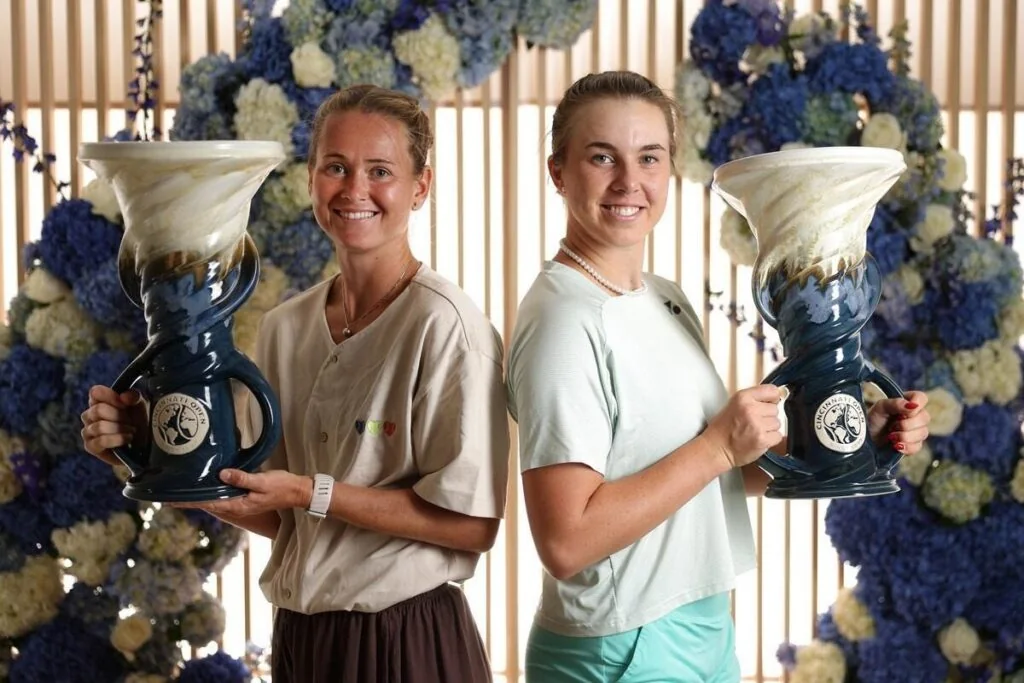
The team milestone was their first title together. The individual records were different: Bouzkova collected her seventh WTA doubles title, and Noskova her second. That distinction matters when reading a player profile. A team begins its shared title count at one, while each partner carries prior trophies won with other teammates.
Official recaps differ in how they describe the exact number of earlier tournaments this pair had played, so this article does not force a count. Both agree on the outcome that matters: they had partnered before, Cincinnati produced their first trophy together, and their complementary styles held through five wins.
Because rankings update and other results arrive, readers should use the current WTA doubles rankings for the resulting positions. The points table explains Cincinnati’s value; it is not a permanent post-event ranking snapshot.
Cincinnati doubles questions answered
Who won the 2026 Cincinnati women’s doubles title?
Marie Bouzkova and Linda Noskova won the WTA title. They beat Magali Kempen and Alexandra Panova 6-1, 6-2 on August 22. It was the Czech pair’s first championship together.
How many teams were in the draw?
There were 32 teams. A champion therefore needed five match wins: round of 32, round of 16, quarterfinal, semifinal and final. Bouzkova and Noskova played and won all five stages.
What happened to Serena and Venus Williams?
The wild-card sisters lost their opening match to Marta Kostyuk and Peyton Stearns 6-2, 1-6, [10-8]. It was their first tournament together since the 2022 US Open, but their 2026 Cincinnati return ended in the round of 32.
Why do some Cincinnati doubles scores show brackets?
A score such as `[10-7]` is a deciding match tiebreak used instead of a conventional third set. Brackets help distinguish tiebreak points from a set score. The first two sets use the WTA doubles No-Ad format.
Is this the men’s or women’s Cincinnati doubles draw?
This is the completed 2026 WTA women’s doubles draw. The ATP men’s doubles and mixed doubles competitions have different teams and results. Check the discipline label before comparing brackets.
Where can I find current WTA doubles matches?
Cincinnati 2026 is complete. Use WTA matches today for current play and verify the event, court and team names. A historical Cincinnati result page should not be treated as a live feed.