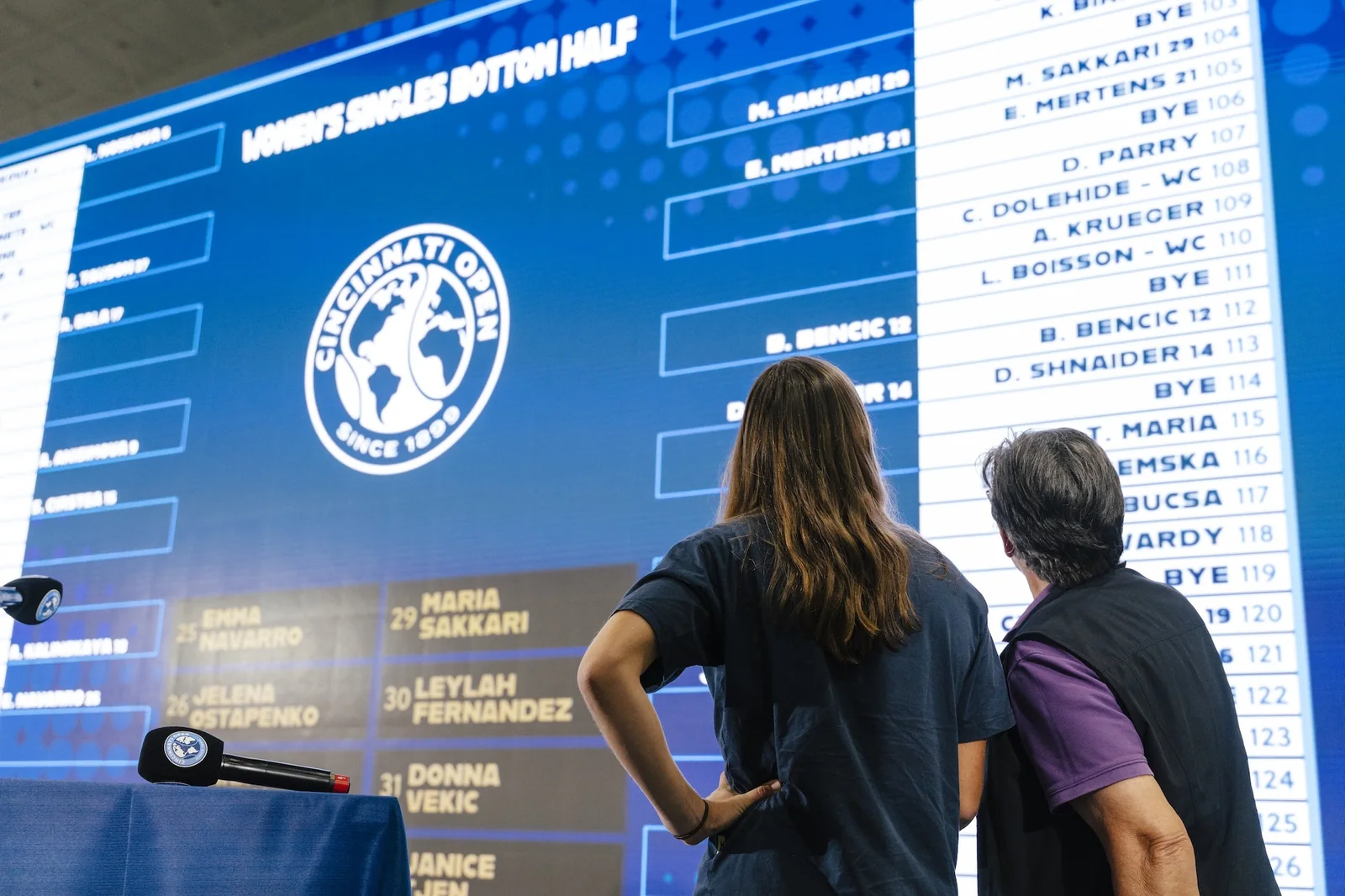
The 2026 WTA Cincinnati draw is complete. Coco Gauff won the women’s singles title over Jessica Pegula, 6-2, 6-4, after a 96-player main draw that also produced semifinal runs by Sara Bejlek and defending champion Iga Swiatek. The authoritative bracket remains the official WTA Cincinnati draw; this guide explains its structure, decisive routes and print options in a more compact form.
Draw size
96 singles places displayed on a 128-line bracket, with first-round byes for the seeds.
Final
No. 4 seed Gauff defeated No. 3 seed Pegula in straight sets.
Draw status
Final scores are available for qualifying, singles and doubles.
A draw is different from an entry list and an order of play. The entry list shows who intended to compete, the draw fixes each player’s route, and the daily order of play assigns those matches to courts and times. Because Cincinnati is finished, readers should use the completed bracket for routes and scores, then consult the Cincinnati schedule and results guide for the day-by-day timeline.
WTA Cincinnati 2026 draw at a glance
The completed women’s draw produced a final between two seeded Americans. No. 4 Coco Gauff came through the upper half, while No. 3 Jessica Pegula advanced from the lower half. Their paths were different: Gauff ended the unseeded run of Sara Bejlek in the semifinals, while Pegula survived a three-set contest against No. 7 Iga Swiatek, the defending champion.
| Round | Match | Completed result |
|---|---|---|
| Semifinal | Sara Bejlek vs Coco Gauff [4] | Gauff 6-4, 6-1 |
| Semifinal | Jessica Pegula [3] vs Iga Swiatek [7] | Pegula 7-5, 4-6, 6-4 |
| Final | Coco Gauff [4] vs Jessica Pegula [3] | Gauff 6-2, 6-4 |
The bracket also records notable earlier exits. Top seed Aryna Sabalenka was stopped by Bejlek in the round of 16, and No. 2 Elena Rybakina’s quarterfinal against Swiatek ended early with Rybakina retiring while trailing 1-4 in the opening set. Those outcomes are part of the final draw; they should not be confused with the quarter-by-quarter projections published before play began.
For a quick check, the late-round map is simple: Bejlek, Gauff, Pegula and Swiatek were the semifinalists; Gauff and Pegula were the finalists; Gauff was the champion. The full bracket remains necessary when a reader needs an early-round opponent, a seed’s exact route or a qualifying placement.
How the 96-player Cincinnati bracket worked
Cincinnati used a 96-player women’s singles field placed on a 128-line bracket. That does not mean 128 women competed. The unused first-round paths were byes, allowing the seeded players to begin in the second round while the remaining players contested the opening round. The expanded format created seven possible match wins for an unseeded first-round entrant and six for a seed entering after a bye.
The initial composition published by WTA was 75 direct acceptances, 12 qualifiers, eight wild cards and one special exemption. Those categories describe how a player obtained a place, not where she landed in the bracket. Once the draw was made, the random placement rules, seed positions and bye lines determined the route.
96 players, 128 lines
The visual bracket includes bye lines. Counting every displayed line as a player would overstate the field by 32.
Seeds entered in round two
A first-round bye reduced the number of wins required, but it did not guarantee an easy opening opponent.
A late withdrawal shows why a final bracket can look different from a seed list published days earlier. Naomi Osaka withdrew on August 12 after the draw had been made but before Thursday’s order of play was released. WTA reported that Katerina Siniakova, the next player eligible to be seeded, moved into Osaka’s seeded line and received the bye; a qualifier or lucky loser filled Siniakova’s former line. The draw therefore displays Siniakova as seed No. 33 rather than pretending the original seed arrangement never changed.
For readers, the practical rule is to trust the final bracket for placement and the dated entry-list article for the original field. Mixing the two can produce a roster with withdrawn players, missing replacements or the wrong opening-round path.
Quarter-by-quarter paths through the women’s draw
The pre-event draw placed the top four seeds as anchors for the four quarters, but only three of those anchors reached the quarterfinals and two reached the final. Reading each quarter separately makes the 96-player bracket easier to understand without reproducing every early-round line.
First quarter: Bejlek breaks through
Sara Bejlek defeated top seed Aryna Sabalenka 7-6(7), 6-4 in the round of 16, then edged No. 20 Madison Keys 3-6, 6-4, 7-6(5) to reach the semifinals.
Second quarter: Gauff takes control
No. 4 Coco Gauff came through her quarter and defeated No. 10 Marta Kostyuk 6-2, 6-2 in the quarterfinals, setting up the semifinal with Bejlek.
Third quarter: Pegula survives
No. 3 Jessica Pegula held off No. 9 Amanda Anisimova 6-4, 2-6, 7-6(4), the close quarterfinal that sent Pegula into a semifinal against Swiatek.
Fourth quarter: an abbreviated finish
No. 7 Iga Swiatek advanced when No. 2 Elena Rybakina retired with Swiatek leading 4-1 in the first set. The bracket properly records a retirement, not an invented straight-set score.
This view also shows the limits of seed-based predictions. Sabalenka’s line did not produce the expected top-seed run, Bejlek reached the last four without a seed number, and Swiatek’s quarterfinal ended before a normal match conclusion. The final bracket is a record of those paths; the preview remains useful only for understanding how the field looked before play.
For early-round opponents and complete scorelines, open the official bracket and select women’s singles. The cards above intentionally summarize only the route from each quarter to the semifinals.
Quarterfinals, semifinals and final draw results
The final three rounds can be read as a compact eight-player bracket. Six of the quarterfinalists were seeded: Keys, Gauff, Kostyuk, Anisimova, Pegula, Swiatek and Rybakina carried seed numbers, while Bejlek supplied the unseeded breakthrough. The results below preserve retirements and tiebreak scores rather than flattening every match into a generic win-loss label.
| Round | Completed result | Next step |
|---|---|---|
| QF | Bejlek d. Keys [20], 3-6, 6-4, 7-6(5) | Bejlek advanced to face Gauff |
| QF | Gauff [4] d. Kostyuk [10], 6-2, 6-2 | Gauff advanced to face Bejlek |
| QF | Pegula [3] d. Anisimova [9], 6-4, 2-6, 7-6(4) | Pegula advanced to face Swiatek |
| QF | Swiatek [7] advanced vs Rybakina [2], ret. at 4-1 | Swiatek advanced to face Pegula |
| SF | Gauff [4] d. Bejlek, 6-4, 6-1 | Gauff reached the final |
| SF | Pegula [3] d. Swiatek [7], 7-5, 4-6, 6-4 | Pegula reached the final |
| Final | Gauff [4] d. Pegula [3], 6-2, 6-4 | Gauff won the title |
A retirement is an official match conclusion but not a completed scoreline. Swiatek’s quarterfinal advancement should therefore be written with “ret.” or explained in words. Likewise, the numbers in parentheses after a 7-6 set are tiebreak points, while square-bracket numbers identify seeds. Keeping those conventions separate helps a printable summary remain faithful to the official draw.
Cincinnati qualifying draw and advancement path
The women’s qualifying tournament was a separate 48-player draw played over August 11-12. Two victories were required to secure one of 12 main-draw places, reducing the field from four players per qualifying path to one qualifier. The main draw began the following day, so successful qualifiers had a compressed transition from earning a place to preparing for their first-round opponent.
A qualifying field announcement is not a list of the 12 women who advanced. It records who was expected to compete before the matches; the completed qualifying tab records the actual winners. Readers should select the women’s qualifying draw on the official WTA page when they need every score, then switch to women’s singles to see where each qualifier landed.
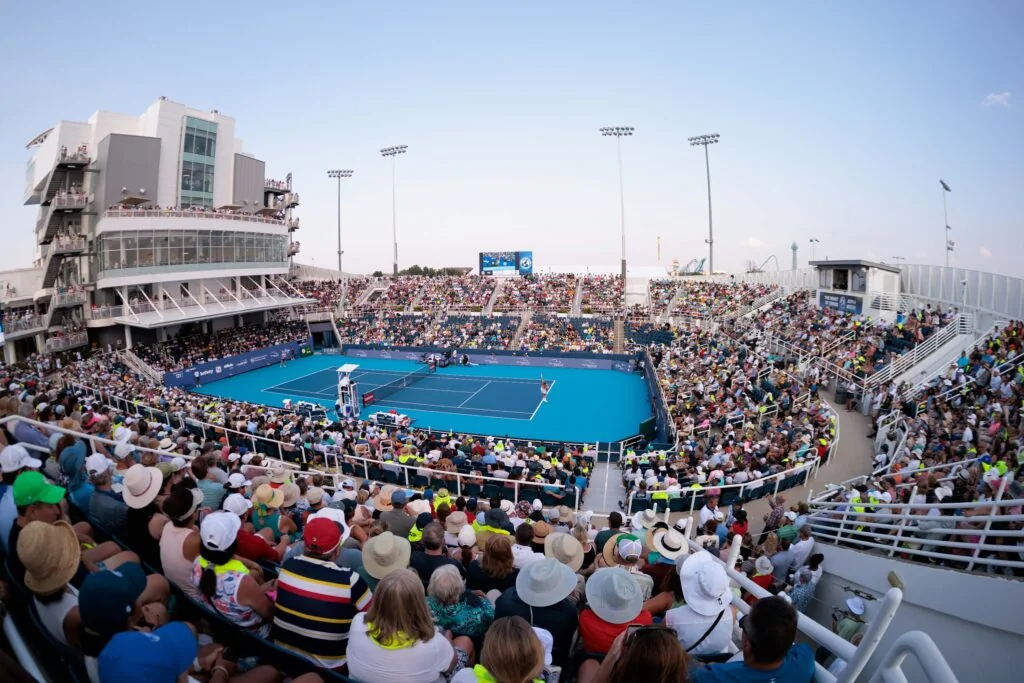
Xiyu Wang provides a useful example of the path beyond qualifying. WTA identified her as a qualifier in the main draw, where she recorded hard-court wins and later advanced to the round of 16 by walkover when Elina Svitolina withdrew before their third-round match. The walkover counts as advancement but not as a played match win over Svitolina; the bracket marks that distinction.
Qualifiers were not “extra” players added on top of the 96. Their 12 reserved positions were already part of the field composition. A lucky loser, by contrast, could enter only after losing in qualifying and then receiving an available main-draw place under the applicable procedure. Entry labels on the final bracket help preserve that difference.
Official draw, PDF and printable bracket options
The safest 2026 bracket is the official WTA online draw because it keeps completed scores, seed labels and draw types attached to the correct tournament year. Select women’s singles for the main bracket, women’s qualifying for the preliminary draw or women’s doubles for the team event. A daily draw sheet serves a different purpose: it organizes matches for one day and may include courts, sessions and both tours.
Search results can surface old Cincinnati PDF filenames with generic labels such as MDS. At least one prominent official PDF result is the 2025 women’s singles draw, not 2026. The Cincinnati name and an official domain do not make the year interchangeable. Before downloading or citing a file, inspect the tournament date printed inside the document and confirm that the player field matches 2026.
How to print the 2026 bracket safely
- 1. Open the official WTA draw and confirm the page is filtered to Cincinnati and 2026.
- 2. Select the correct draw type before printing; singles, qualifying and doubles are separate records.
- 3. Expand or scroll through the required rounds so late-round scores are visible.
- 4. Use the browser’s print dialog and choose landscape orientation if the bracket is clipped.
- 5. Label the output accurately as a browser print of the official online draw, not an official tournament PDF unless the source supplied a PDF.
On a narrow phone screen, a bracket may require horizontal movement and can produce an incomplete print preview. A desktop browser or “save as PDF” print destination is usually easier. That locally saved file is convenient for personal reference, but it remains a user-created printout. It should retain the source URL and access date because corrections or entry labels can be updated online.
Readers who only need the champion and final rounds can use the tables above. Readers who need every line should favor the official dynamic bracket over a copied image, which quickly becomes unreadable and may omit early-round scores.
WTA Cincinnati draw FAQ
Where is the official WTA Cincinnati 2026 draw?
The official WTA tournament draw page is the best complete source. Confirm Cincinnati, select 2026 and choose women’s singles. The same interface can expose qualifying and doubles, so a reader who lands on an unfamiliar set of names should check the draw selector before assuming the bracket is wrong.
How many players were in the women’s singles draw?
The field contained 96 players. It was displayed on 128 bracket lines because the 32 seeded positions received first-round byes. Those empty paths are structural lines, not missing player records. An unseeded first-round entrant could need seven wins for the title, while a seed entering in round two needed six.
Who won the 2026 Cincinnati women’s draw?
No. 4 seed Coco Gauff completed the bracket as champion, defeating No. 3 Jessica Pegula 6-2, 6-4 in the final. Sara Bejlek and No. 7 Iga Swiatek were the other semifinalists. The final bracket, rather than a pre-event projection, is the source for those outcomes.
Why does Katerina Siniakova appear as seed No. 33?
Naomi Osaka withdrew after the draw was made. WTA reported that Siniakova was the next player eligible to be seeded, so she moved into Osaka’s seeded line and received the bye. The No. 33 label records that replacement process; it does not mean Cincinnati originally planned 33 seeded places.
How did women’s qualifying work?
Forty-eight women competed over two rounds on August 11-12 for 12 reserved main-draw positions. A qualifying entry list showed who entered that preliminary event, while the completed qualifying draw showed the 12 players who won through. The labels should not be treated as the same document.
Was there a separate women’s doubles draw?
Yes. The doubles draw was a team bracket with its own dates, results and entry labels. It should not be mixed into the singles bracket simply because both appear on the same WTA tournament page. Use the doubles selector or the dedicated Cincinnati women’s doubles guide.
Is there an official 2026 printable PDF?
The verified primary source for this guide is the official online 2026 draw. Search results may expose prior-year official PDFs, including a 2025 women’s singles file. A browser can print or save the 2026 online bracket, but that output should be described as a printout of the official page unless the tournament explicitly supplies a 2026 PDF.
What is the difference between a bye, walkover and retirement?
A bye places a seeded player directly into round two without an opponent or result. A walkover advances a player before a scheduled match starts, as Xiyu Wang did when Elina Svitolina withdrew. A retirement follows at least some play, as in the Rybakina-Swiatek quarterfinal, so a partial score remains in the bracket.