
What the WTA financial reports establish so far
The WTA faces reported cash pressure, but a projection of a future shortfall is not evidence that the tour has already entered bankruptcy. September reporting described a risk of exhausting cash in late 2027 if the current rate of losses continued. That condition is essential to understanding the story.
The September 11 Tennis Majors report attributes the figures to reporting by The Telegraph. It should be read as a report about a forecast, rather than as an independent audit of the tour's current bank balance. This guide reflects information available on October 29, 2026.
Three different questions sit behind the headlines. How much money was projected to remain at a future date? What ongoing costs and receipts produced that projection? And can changes in the business alter the path before the projected shortage occurs? Those questions deserve separate answers. Treating them as one inevitable outcome makes it harder to evaluate both the financial concern and management's response.
A sports organization can have a valuable platform and still face difficult cash decisions. Likewise, announcing a promising commercial strategy does not demonstrate that the immediate pressure has disappeared. The useful assessment connects the reported figures with the operating model, the timing of receipts and the evidence that a new strategy is producing repeatable results.
Where the cash forecast came from
One reporting chain does not equal several audits
The financial warning originated in The Telegraph's September 9 reporting. Tennis Majors' September 11 account identifies the original journalists as Simon Briggs and Sonia Twigg and describes figures presented during meetings in New York. It reports projected year-end 2026 cash of $15 million and an operating loss of $23 million for 2026.
Those are reported projections, rather than a complete set of accounts reproduced here. A later article repeating the same figures does not create a second independent financial verification. The important distinction is between additional reporting that supplies new evidence and additional coverage that summarizes the original story.
This does not make the concern unimportant. It identifies what evidence is actually being assessed. The same forecast appearing in many headlines can make the situation feel more conclusively established than the underlying source chain warrants. A careful discussion can take the warning seriously while continuing to attribute the figures correctly.
Cash reserves, annual losses and a future shortfall
Cash is a balance available at a point in time. An annual operating loss describes performance over a period. The two are connected, but subtracting one headline from another does not produce a reliable date when an organization runs out of money. Accounting income and expenses can be recognized at different times from the associated cash receipts and payments.
Consider an invented organization holding 10 units of cash and spending a net two units each month. If nothing changes, the simple cash runway is five months. If a customer pays six units early, the path changes immediately. If an unexpected event creates another expense, it changes in the other direction. This is basic arithmetic, not a calculation of the WTA's actual runway.
Sports cash flows can also be uneven. An event may incur preparation costs before ticket receipts or sponsorship installments are fully collected. A yearly average can hide pressure around a particular payment date. Conversely, receiving money in advance can temporarily make a balance look healthier without proving that the underlying activity is profitable.
That is why the condition attached to the reported forecast matters. Cost reductions, new commercial receipts, changed event arrangements or additional funding could alter the path. Whether they actually do so is an evidence question. A future shortage scenario identifies what might happen under specified assumptions; it cannot by itself establish that bankruptcy has occurred or that the published tournament calendar will be cancelled.
What Camillo said about the 2026 transition
In her October 15 Served interview with Andy Roddick and Jon Wertheim, Camillo described 2026 as a transition year. She connected the unexpected, compressed relocation of the Finals to Indian Wells with the WTA taking direct responsibility for delivering the event and covering its prize money.
Fiscal discipline and the unexpected Finals expense
Her response emphasized fiscal discipline alongside a strategy of taking control of the event and pursuing greater commercial opportunity. She argued that one year's picture should not be treated as a permanent pattern, while acknowledging that having to relocate the Finals repeatedly would create problems. That is a management explanation of the situation, rather than a declaration that the reported pressure has vanished.
The distinction is practical. Unexpected spending can produce a particularly difficult year even when the underlying operation has valuable assets. But calling a cost unusual is only part of the answer: the organization still has to fund that cost, meet its obligations and show that future spending will follow a more sustainable path. The explanation is relevant, while the eventual financial outcomes remain important.
Fiscal discipline can involve choosing priorities, controlling expenses and understanding when commitments must be paid. It is more useful to assess the concrete consequences than to treat the phrase itself as a turnaround. Cutting a cost that adds little value can improve the business; cutting an activity that helps attract audiences could have a different long-term effect. The quality of the decisions matters alongside the amount saved.
The same applies to growth ambitions. A strategy can identify assets that management believes are undervalued, but that belief needs to become contracts, collected revenue and useful operating results. Camillo's account explains why the WTA wants a different relationship with its flagship event. It does not supply enough information to calculate a guaranteed date when every financial concern will be resolved.
Why operating the WTA Finals changes the business model
A fixed licence payment versus running an event
Camillo explained in the interview that third-party operators had previously licensed and promoted the Finals. The new ambition is for the WTA to exercise greater control. In business terms, that changes the relationship between the organization, the event's revenues and the work required to deliver it.
A licensing arrangement can offer a defined payment under agreed terms. Direct operation can give the rights holder a greater share of the benefit if ticketing, sponsorship, hospitality and other commercial activity perform well. The tradeoff is that somebody must also manage the costs and the risk that demand falls below expectations. Exact responsibilities depend on contracts, so the model should not be reduced to an assertion that one side always carries every risk.
Consider an event that sells more tickets than expected. A fixed payment may not rise with every additional sale. An operator participating directly in that revenue can benefit more, but only after accounting for the expenses involved. Higher gross receipts and higher profit are not interchangeable. An event could sell more while also becoming more expensive to produce.
The strategic appeal is control over decisions that affect the experience: how commercial opportunities are packaged, how the event is presented and how local relationships are developed. That control creates room to improve the business. It also makes execution more consequential, because a plan must become an event that people want to attend, watch and support again.
Indian Wells, Charlotte and the value of a stable home
The September 16 WTA announcement positions Indian Wells in 2026 as a bridge to Charlotte. It confirms Spectrum Center as the Finals venue for 2027–2029. Mecklenburg County's announcement describes the partnership with the WTA, Charlotte Sports Foundation and state and local organizations.
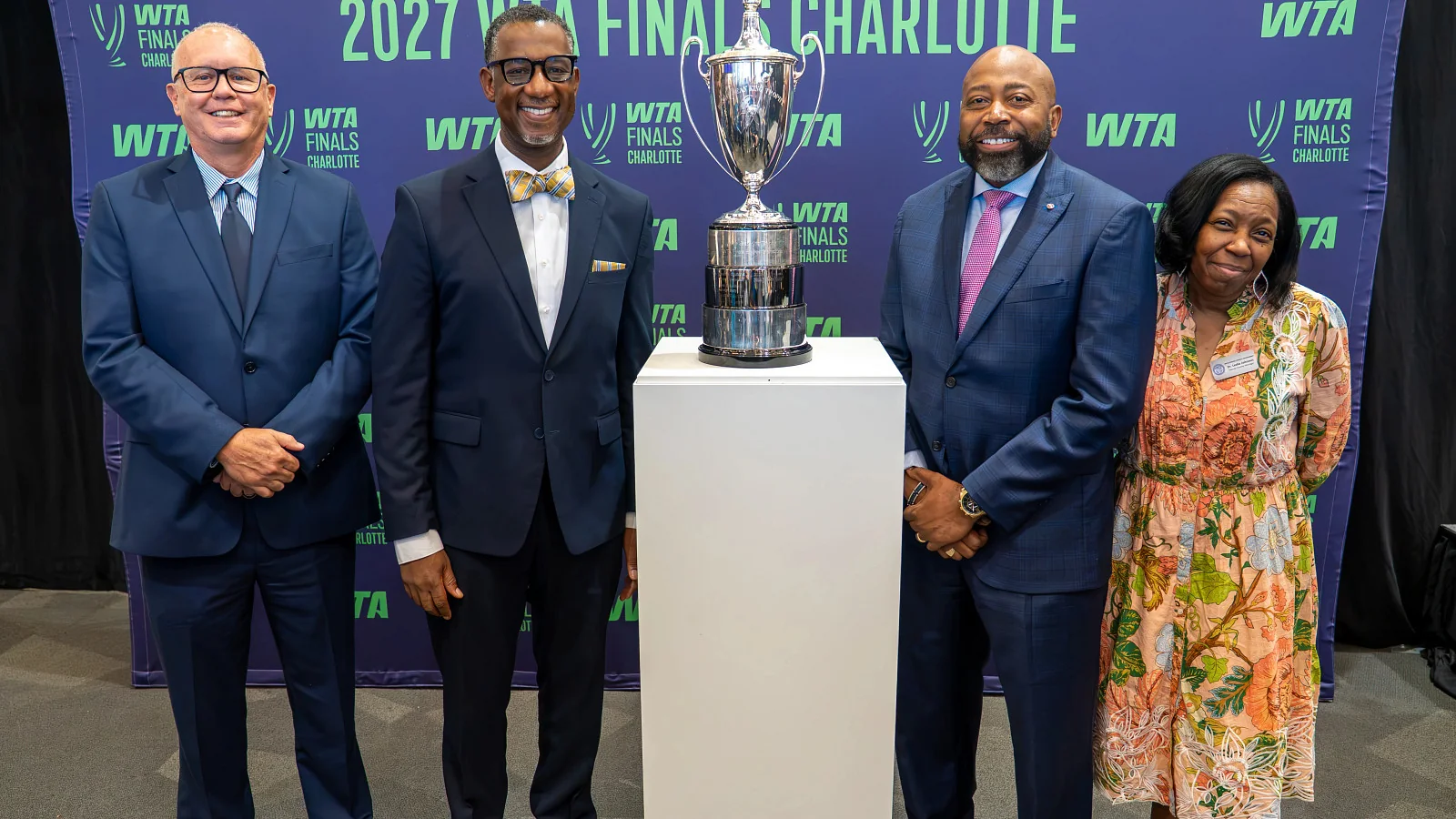
A stable location can give organizers time to build repeat attendance, recognize what worked in an earlier edition and develop longer commercial relationships. It can also reduce the need to introduce the event to a completely new local market every year. Those are reasons a multi-year agreement could help, rather than proof that a particular edition will turn a profit.
Success still requires a compelling sporting presentation and sound delivery. A good venue is one ingredient; access, promotion, scheduling and the overall experience influence whether people return. Our Charlotte Finals guide covers the event details separately. The financial issue is whether the new operating arrangement converts that platform into durable value after costs.
Where commercial growth could come from
Sponsorship and the value of the Finals platform
There are identifiable commercial developments beyond statements of ambition. The WTA's long-term Mercedes-Benz partnership began in January 2026, with the company becoming Premier Partner and Exclusive Automobile Partner. In May, the WTA announced Accenture as its business and technology consulting partner, supporting modernization of the digital ecosystem.
These announcements show commercial activity, but they do not publish enough detail to calculate the WTA's current net cash position. A partner's name is not a complete payment schedule. The value of a relationship can include services and other benefits alongside money, while delivery can require spending of its own. The appropriate question is what each agreement contributes after its obligations are met.
A flagship championship can offer a concentrated platform for sponsors because it connects season-long sporting achievement with a defined event. The business opportunity is to make that association valuable to the partner and useful to fans. Merely adding more logos would not necessarily improve the experience. A stronger product might combine clear storytelling, accessible competition and relevant on-site or digital activities.
Broadcasting, distribution and the fan experience
In August, WTA Ventures appointed IMG as managed production services partner in a multi-year agreement beginning in 2027. The announcement covers more than 50 events each season, with services varying by tournament and including broadcast production, world feeds, distribution, technical operations and short-form content.
Camillo's October interview also emphasized greater control of media and production. The official agreement supplies a concrete example of that direction. Production is the work of creating and delivering coverage; rights agreements determine who may distribute it in particular markets. Improving one part of that chain does not automatically settle every question about access, subscriptions or financial return.
From a fan's perspective, commercial growth has a practical test: is it easier to find and follow the sport? Reliable coverage, clear scheduling and compelling context can help a casual viewer stay for the next match. A clip that attracts attention is useful, but the route from that clip to a full match also matters. Audience discovery and continued viewing are connected parts of the same opportunity.
For the business, the challenge is to produce those improvements at a cost justified by the value created. A more consistent production system could support efficiency as well as presentation, but the agreement alone does not establish its future savings or profit. Those outcomes will need to be judged after implementation rather than assumed from the scale of the announcement.
How equal prize money fits into the financial debate
Equal prize money is both a central sporting objective and a commitment that needs durable funding. The October 1 WTA announcement confirms parity across all combined WTA 1000 events in 2027 and introduces a targeted Tournament Investment Fund. It does not publish the fund's event-by-event allocations.
The question of who finances a prize fund cannot be answered by looking only at the name of the tour. A tournament can draw on its own commercial receipts, sponsor support and other arrangements. Canada's announced pathway, for example, identifies National Bank support and resources from WTA Ventures. The funding mix needs to be understood before assigning the whole cost to one organization.
This matters when financial headlines become an argument about a single policy. A claim that parity alone caused the WTA's entire reported shortfall would require evidence separating its effect from event relocation, operating expenses, commercial receipts and other changes. The reverse claim—that a worthwhile equality objective removes every concern about its financing—would also avoid the practical question. A commitment can be important and still require careful financial design.
Prize-money parity and revenue sharing are separate questions too. Equal awards for women and men at an event do not establish what proportion of that event's total income goes to athletes. A player can support parity while asking for a larger share of revenue. Our Grand Slam prize-money protest guide explains that distinct debate.
For the Finals, the size of a payout is only one part of the event's financial story. The business must also support delivery and meet payment commitments at the required time. Readers looking for the awards themselves can use the 2026 Finals prize-money guide; readers assessing sustainability need the relationship between those obligations and the sources of funding.
A strong long-term model would align the sporting promise with revenue that can be generated repeatedly. That does not mean every event must look identical or rely on exactly the same partners. It means the commitment should be supported by arrangements that make sense for the market and remain credible after an unusually successful week, a temporary funding receipt or an unexpected cost has passed.
What would demonstrate that the strategy is working?
The strongest evidence would connect commercial progress to financial outcomes. More partners, better coverage and a stable Finals location can support the strategy, but a credible assessment also needs to consider the money collected, the costs incurred and the timing of both. A growing audience and a manageable cash position are related objectives, rather than interchangeable measurements.
The distinction is visible in earlier official reporting. In December 2024, WTA Ventures said it expected commercial revenue to increase by 24 percent in its first full year. That is useful historical context about commercial ambition. It is not a statement of 2026 profitability, and revenue growth alone cannot answer a question about the present cash balance.
For the Finals, repeat attendance and returning partners would help show that the event is becoming a durable proposition. Operationally, the quality of delivery and the ability to keep costs aligned with the experience matter. For media, consistent coverage and easier audience engagement would make the announced production changes more tangible. Financially, recurring receipts are more informative about sustainability than a one-time injection viewed in isolation.
The relevant comparison will also change with time. A forecast made during the US Open can be reassessed when new arrangements take effect or when actual financial results become available. An update should identify what changed in the assumptions rather than simply repeat an old shortage date as if nothing had happened since.
Camillo has outlined a route based on discipline, control and commercial growth. The reported cash warning explains why execution matters. Fans can follow the sporting calendar while judging the business through concrete evidence of delivery and repeatable results, without assuming either that a forecast guarantees collapse or that an ambitious strategy guarantees a turnaround.