
Yes, top-10 players can play WTA 250 tournaments
Top-10 players are not universally banned from WTA 250 events. Eligibility depends on the tournament week, the relevant entry-deadline ranking, the available entry route and the player's annual allowance. When a WTA 500 runs in the same week, the Play Up Rule restricts certain top-30 players, with defined Play Down Exemptions rather than an unrestricted choice of the smaller event.
The misleading shortcut is that a top-10 player can only play a 250 in her own country. A local-player exemption is one route in a restricted week. A defending champion can have another route, and a week without a WTA 1000 or WTA 500 is governed differently. The 2026 WTA rulebook, checked on October 29 against its July 27 revision, also contains separate tournament and annual player limits.
Think of eligibility as several gates. First identify the kind of week. Then determine the player's status at the applicable deadline. If an exemption is needed, establish the qualifying category and whether the tournament has nominated and accepted the player. Finally check the tournament's capacity and the player's remaining allowance. Passing one gate does not automatically pass the others.
This matters when reading an entry list. A player appearing at a 250 is not, by that fact alone, evidence of a secret exception or preferential treatment. Equally, a strong ranking does not guarantee that a tournament can accept a player through any route she chooses. The draw is produced by the interaction of sporting rank and the entry rules.
Our mandatory tournaments guide addresses what players are required to play and how missed commitments affect rankings. The question here is narrower: when may a leading player enter the smaller tournament? An obligation to play enough 500s during the year and permission to enter a particular 250 are related considerations, but they are not the same rule.
When the Play Up Rule restricts a top-30 player
The restriction applies in a week containing both a WTA 500 and a WTA 250. A player ranked from No. 1 to No. 30 at the relevant singles main-draw entry deadline cannot play the 250 in singles or doubles if her singles ranking would qualify her for the 500 main draw, unless she receives a Play Down Exemption.
The WTA 500 acceptance test matters
The phrase “top 30 cannot play a 250” leaves out an important condition. A top-30 player who does not qualify for the same-week 500 main draw may play the 250. The relevant comparison is with acceptance at that larger tournament, not simply whether the player is famous or appears near the top of a rankings page.
In a hypothetical exceptionally strong 500 field, a player could be inside the top 30 but outside its direct main-draw acceptance. The rule does not tell her to remain idle merely because her ranking is No. 29. Conversely, choosing not to enter a 500 does not by itself eliminate the test of whether her rank qualifies her. The wording is designed around qualification for acceptance, rather than a voluntary declaration of preference.
Use the entry-deadline ranking, not today's ranking
The official entry provisions use the applicable deadline snapshot. Normal main-draw entry deadlines are four weeks before the Monday of the tournament week unless WTA specifies otherwise. Rankings can change considerably between that point and the first match.
Suppose a player was No. 28 at the relevant deadline and later falls to No. 35. Looking only at her new ranking could wrongly suggest she was outside the restricted group. Reverse the example: a player at No. 35 who rises to No. 28 before the event did not necessarily have top-30 status at the deadline. The same logic explains why an event's seed number is not a substitute for the required entry ranking.
Use our rankings page for current standings, but retrieve the relevant historical list when checking an individual entry. A correct answer needs both the number and its date. Without the date, an otherwise accurate ranking can answer the wrong eligibility question.
The three routes to a WTA 250 Play Down Exemption
When a player is caught by the Play Up Rule, eligibility for an exemption comes through one of three categories. The category explains why a request can be considered. Tournament approval, nomination, available places and the player's remaining annual allowance still matter.
Returning as the defending singles champion
The prior year's singles champion qualifies for the defending-champion category if the tournament remains within a 125-mile radius of the previous venue and in the same host country. “She won this tournament before” is too broad: it is specifically the immediately preceding year's singles title, with geographical continuity requirements.
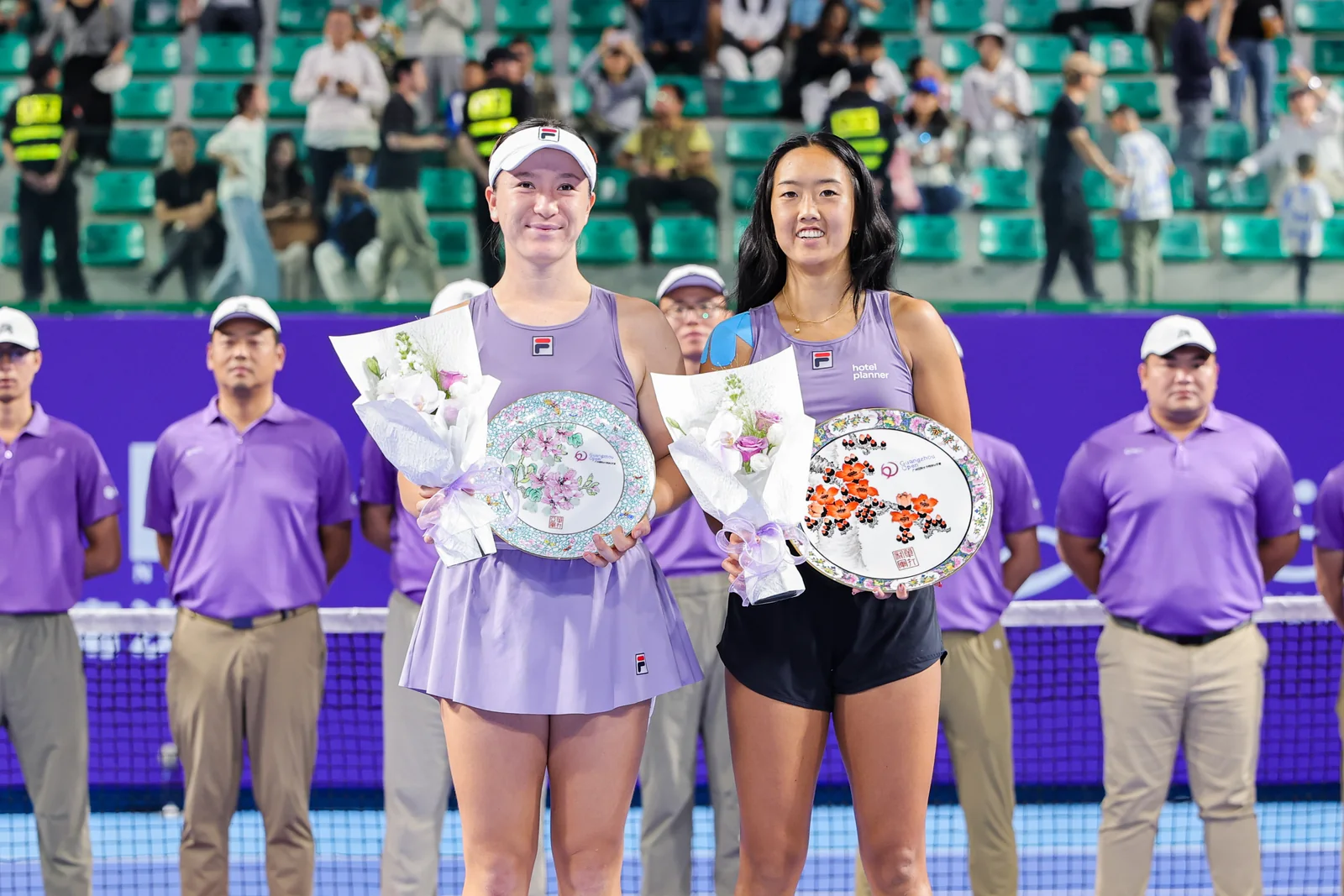
For dated examples of who the preceding champions were, Leylah Fernandez won Osaka in 2025, and Ann Li won Guangzhou in 2025. Those facts identify champion status; they do not by themselves establish that either player needed or used an exemption in 2026. That requires the deadline ranking and acceptance test too.
Playing in the country of the player's nationality
The local-player category uses the player's nationality under WTA rules and the tournament's country. It does not simply mean the player lives nearby, trains at the venue, has relatives in the country or receives especially enthusiastic support there. Those can explain an athlete's connection with an event without creating this particular eligibility category.
For a hypothetical top-10 local player, this can provide a route that an otherwise similarly ranked overseas player lacks. But local status is not unlimited admission: the tournament's ordinary top-10 slot and the confirmation procedure still apply. A home audience's wish to see several stars is not another exemption category.
Being ranked from No. 11 to No. 30
A player in the No. 11–30 band at the main-draw deadline can qualify through that category. A top-10 player cannot use it merely because she was No. 15 earlier in the season. The relevant snapshot is the one required for the event.
These distinctions explain the different treatment of No. 9 and No. 19 in a 500 week. The latter can qualify through the ranking-band route; the former would need a different applicable route. Even so, neither has an automatic right to be selected ahead of another eligible candidate. The next question is how the tournament allocates its limited places.
Tournament limits depend on the week and the entry mechanism
A 250 cannot accept every eligible exemption candidate. In a same-week 500 arrangement, its allocation normally allows one defending champion, one local player and one player ranked No. 11–30. If either of the first two categories is absent or does not require an exemption, the allocation can include a second No. 11–30 player.
There is an important ceiling within that adjustment. If neither the defending-champion nor local-player exemption is used, the rulebook's allocation table permits two No. 11–30 players in total, rather than three. It is therefore inaccurate to describe every restricted 250 as having three freely interchangeable exemption places. The category mix determines the total.
The ordinary top-10 limit is also one player, including a top-10 defending champion or local player. If both those candidates are top-10 players, the ordinary provision requires the event to choose one. Qualifying for different exemption categories does not itself create two ordinary top-10 slots.
A week without a WTA 1000 or WTA 500 is different
When a 250 is scheduled in a week without a WTA 1000 Mandatory or WTA 500, players ranked No. 11 or below at its deadline may play under that week's entry provisions. The ordinary top-10 acceptance remains limited and has its own nomination process. A top-10 player does not have to invent a local or defending-champion connection simply because the event is a 250.
There is also a separate tournament mechanism in Section XIV.C.2 of the official rulebook: a 250 may increase prize money to accommodate additional top-10 players, adding $250,000 for each extra top-10 acceptance. WTA requires written confirmation of the increase before accepting those additional entries; the tournament can notify it up to qualifying sign-in.
This is a tournament prize-money provision, not a payment made by a player to buy eligibility. It should not be treated as a blanket waiver of the Play Up Rule, the need for an applicable entry route in a restricted week, or annual player limits. When an event presents an unusually strong field, check which mechanism and confirmations it actually used before assuming that the ordinary limit was ignored.
In practical terms, separate two questions: “Can this player qualify for admission?” and “Can this tournament accept another player in that category?” The first concerns the athlete's status. The second concerns the event's allocation and, where relevant, its additional commitments. An answer to only one leaves the entry explanation incomplete.
The annual limits apply to the player as well
A top-30 player may receive two Play Down Exemptions for 250 tournaments held in the same week as a WTA 500 during a Tour Year. That is a player-level allowance, separate from how many exemption players an individual tournament can accept.
For a top-10 player, another annual rule applies. She may play three WTA 250 tournaments only if she played all her WTA 500 Commitment Tournaments in the preceding Tour Year. Otherwise, her allowance is two. The extra third event is therefore conditional, rather than a standard three-event entitlement for every top-10 player.
A worked example makes the difference clearer. Suppose an eligible top-10 player has the three-event annual allowance. She uses a permitted exemption for one restricted-week 250 and another for a second restricted-week 250. A third 250 in a week without a 1000 or 500 would be a different eligibility situation. But a third event requiring another Play Down Exemption would run into the two-exemption limit even though the overall annual event allowance is three.
Conversely, a top-10 player limited to two annual 250 events cannot solve that restriction simply by choosing a week without a 500. A different kind of week can remove the need for a Play Down Exemption; it does not automatically expand the player's yearly allowance.
Withdrawals also require care. Under the WTA player restrictions, a confirmed exemption or top-10 player withdrawing after the specified confirmation, entry-deadline or wild-card stages can still use one of her permitted 250 events, with a Long-Term Injury exception. Counting only completed main draws can therefore produce the wrong total.
Do not infer an individual player's remaining allowance from a quick look at this month's results. Check her season's confirmed entries and applicable withdrawal circumstances. The commitment guide helps with the separate prior-season obligations. Announced changes for 2027 should also be read as next-season changes, not assumed to have already rewritten a 2026 entry decision.
Why a wild card does not automatically solve the restriction
A wild card is an entry method, not a universal override of WTA 250 restrictions. A tournament can use a later wild card for an eligible exemption player under the relevant procedure. That does not mean it can invite any otherwise restricted top-10 player simply by adding “WC” beside her name.
Nomination, acceptance and replacement are separate steps
For a same-week Play Down Exemption, the tournament submits its nomination form by 2 p.m. Eastern Time on its singles main-draw entry-deadline day. Confirmed exemption players then submit acceptance forms. The event can also identify eligible alternates. A top-30 player entering without being nominated is not thereby a confirmed exemption player at that deadline.
Imagine three announcements: an athlete says she hopes to play; the tournament lists her among prospective entrants; the final acceptance list confirms her place. These are different levels of certainty. The first can express intent without settling eligibility. The second can describe a developing field. The third should reflect the completed acceptance process. Fans planning attendance should be careful about treating all three as equivalent guarantees.
Replacement procedures add another layer. If a confirmed direct-acceptance exemption player withdraws after the main-draw deadline but before qualifying sign-in, the same-category nominated alternate has priority. If no applicable alternate is available, the rules provide for an eligible replacement within the specified period. Later replacement before the draw is made is also subject to the event's entry restrictions.
These details explain why a late addition can be valid even when the initial list looked different. A change is not automatically evidence of a special exemption invented for a star. The question is whether the replacement was eligible and accepted through the correct stage, using the appropriate ranking date.
The official entry and draw provisions should be used for a close case. “She got a wild card” answers how a place was assigned. It does not fully answer why she was eligible for that place. Keeping those questions apart is particularly useful when an event is advertising a returning champion or a local player whose current ranking has changed since entries closed.
A practical way to check an unexpected WTA 250 entry
Start with the tournament's actual category and week on the WTA calendar. A WTA 125 has separate restrictions; a WTA 250 is not just another name for the same level. Also distinguish Osaka the city and tournament from Naomi Osaka the player when searching for the Japan Open.
- Identify the concurrent events. Is a 500 running that week, or is this a week without a 1000 or 500?
- Retrieve the entry snapshot. What was the relevant singles ranking at the applicable main-draw deadline?
- Check the larger-event test. If the player was top 30, would her ranking qualify her for the same-week 500 main draw?
- Establish the route. If an exemption is needed, is she a qualifying defending champion, a local player or a No. 11–30 player?
- Check confirmation and capacity. Was she accepted through the required procedure, within the tournament's allocation or applicable additional-entry mechanism?
- Check the annual allowance. Has the player already used the relevant exemption or event limit, including withdrawals that count?
For the recent Asian schedule, our Osaka tournament guide and Guangzhou guide provide the event context. Neither a tournament's seed list nor its promotional headline replaces the historical ranking and acceptance information needed for a player-specific verdict.
If a necessary confirmation is not public, that individual entry may remain unexplained from the available documents. That is a limit of the evidence, not proof that the rule has been broken. The reliable general answer is that top-10 players can play 250s under defined conditions. Home nationality is one possible route, a wild card is one possible method, and both still sit within a larger set of tournament and player restrictions.