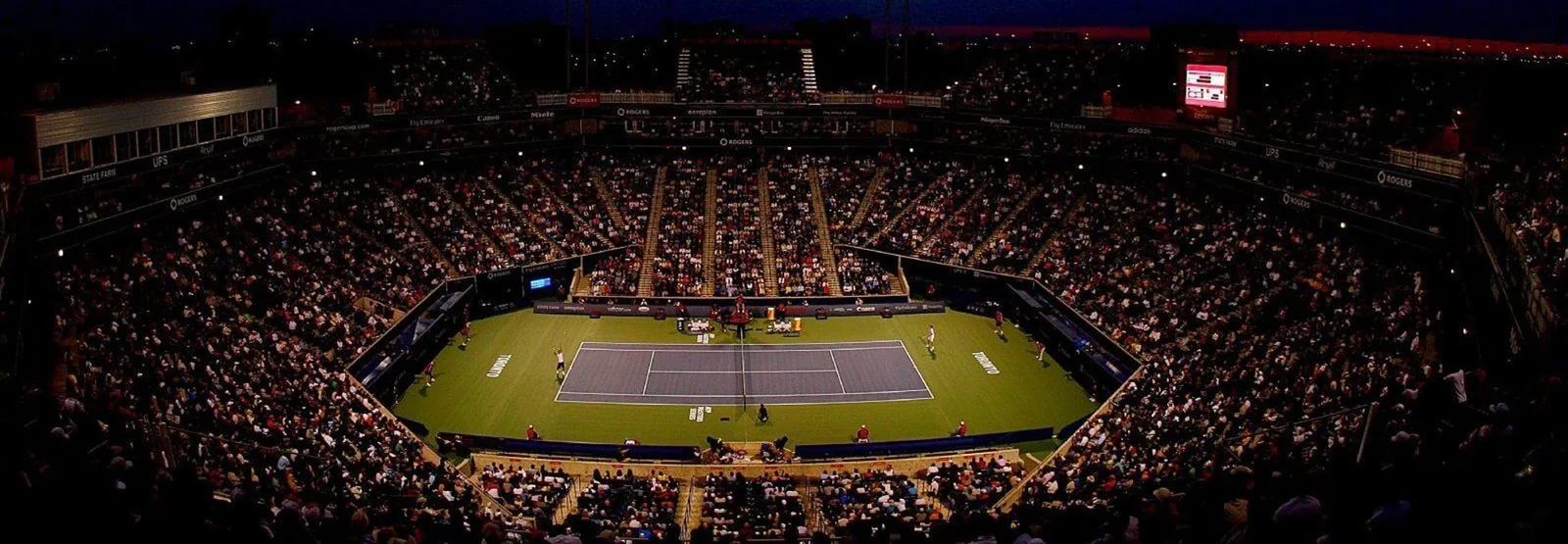
WTA Toronto 2026 prize money: quick answer
The 2026 WTA Toronto singles champion receives $1,085,220 and 1,000 WTA ranking points. The finalist receives $564,920 and 650 points. The WTA publishes both prize amounts in U.S. dollars, so they should not be presented as Canadian-dollar figures without a dated currency conversion.
Champion
$1,085,220
1,000 WTA points
Finalist
$564,920
650 WTA points
Total commitment
$7,433,076
The broader event figure
Those three headline numbers answer different questions. The champion and finalist values are the gross singles awards attached to their finishing positions. The $7,433,076 figure is labeled “Total $ Commitment” on the official WTA tournament page. It is not the winner’s cheque, and it should not be relabeled as the singles prize-money pool.
Toronto is a 96-player WTA 1000 tournament on outdoor hard courts. Winning it is worth the category’s headline 1,000 points, but a player’s ranking total may rise by less than 1,000 because the WTA system also considers expiring results and which tournaments count. Prize money and ranking points should therefore stay in separate columns.
The round amounts are cumulative finishing awards rather than bonuses paid after every match. A champion receives $1,085,220 in published prize money, not that amount plus the finalist, semifinal and earlier-round lines. The same principle applies to a player eliminated in any other round.
These figures were rechecked against official WTA sources on August 13, 2026. The event was on its final day at the research cutoff, so this guide does not assign the champion’s award to a player before an official result is posted. The dated Toronto tournament page remains the result reference.
Complete singles prize money and points breakdown
The official WTA hard-court guide publishes the following Toronto-specific singles distribution. Its “fourth round” is the round of 16 in the 96-player bracket. Every money figure is in U.S. dollars, and each points figure is tied to the player’s final round reached.
| Finish | Points | Prize money | Increase from prior finish |
|---|---|---|---|
| First round | 20 | $18,420 | Entry award |
| Second round | 35 | $28,245 | +$9,825 |
| Third round | 65 | $47,605 | +$19,360 |
| Round of 16 | 120 | $81,800 | +$34,195 |
| Quarterfinal | 215 | $154,354 | +$72,554 |
| Semifinal | 390 | $297,315 | +$142,961 |
| Finalist | 650 | $564,920 | +$267,605 |
| Champion | 1,000 | $1,085,220 | +$520,300 |
The increase column is straightforward subtraction supplied for reader context; it is not a separate WTA bonus. For example, reaching the final instead of stopping in the semifinal raises the published award by $267,605 and the points award by 260. Winning that final adds another $520,300 and 350 points compared with runner-up.
A source nuance matters at the first-round line. The WTA’s general 96-player ranking chart displays 10 under R128, whereas its current Toronto event article explicitly lists first round as 20. This table follows the event-specific 2026 Toronto article. Anyone reconciling a particular player’s official points should check the finalized WTA record after the event rather than silently substituting the generic chart.
A seeded player’s bye does not allow her to add the first-round amount to a later award. The table records one finishing position, not a sequence of installments. Qualifiers also have special points rules, so their official total cannot always be reconstructed by adding every visible main-draw row.
The Toronto draw and printable-bracket guide maps these labels to the tournament’s seven main-draw rounds. That prevents “fourth round,” “round of 16” and the fourth match played from being confused when byes are involved.
What the champion and finalist actually earn
The published winner’s award is $1,085,220, while the runner-up’s award is $564,920. One victory in the final is therefore worth an additional $520,300 and 350 ranking points compared with losing that match. These are finishing-position values, not match fees layered on top of every earlier round.
Finalist outcome
$564,920 and 650 points. This is the complete published finalist award, rather than a bonus added to the semifinal line.
Champion outcome
$1,085,220 and 1,000 points. The title pays about 92.1% more money and awards about 53.8% more points than runner-up.
Those percentages compare official table entries; they do not measure personal profit. A touring professional may pay coaches, trainers, agents, travel, accommodation, insurance and medical costs. Tax withholding and the final tax position can also depend on residence, source-country law, treaties and personal circumstances.
The WTA rulebook discusses player income-tax deductions and makes clear that players are responsible for their taxes. It does not support one universal Toronto “take-home” calculator. A credible guide should therefore call the published number a gross prize award and stop short of estimating what reaches an individual player’s bank account.
Career prize-money totals need the same caution. They track recorded competition earnings, not salary, endorsements or net worth, and they do not subtract the cost of operating a professional tennis career. Comparing Toronto’s winner’s cheque with a player’s career figure can provide scale, but it cannot establish wealth.
The 350-point final-match difference is also a face-value award. Its effect on ranking position depends on the player’s existing points record. That is why the money difference can be stated exactly now, while the next official ranking should be checked separately on the WTA rankings page.
At the August 13 cutoff, official event materials placed Toronto on its final day. The award table is fixed, but this section does not attach the champion amount to an unconfirmed winner. Once the result is official, the player’s name changes the historical record; it does not change the published award for the position.
How Toronto ranking points affect a player’s total
A Toronto champion earns 1,000 points from the tournament, but her published ranking total does not automatically rise by 1,000. The WTA uses a rolling, cumulative results system. As results enter and leave the counting window, a new Toronto score may replace older Canada points or another weaker result rather than being added without subtraction.
Scenario A: a clean improvement
A player has few Canada points to defend, and Toronto fills an eligible counting slot. Most or all of the new award can improve her total, although the official list still controls.
Scenario B: replacing an old result
A player is replacing 390 points from the comparable cycle with 650 for reaching the final. Before other rules or results intervene, the improvement is 260 points, not 650.
Scenario C: a stronger result already counts
If the relevant results bucket is already full of larger scores, a modest Toronto finish may add less than its face value or make no net improvement.
For leading singles players, the WTA’s public explanation includes four Grand Slams, the best six results among seven combined WTA 1000 events—Toronto/Montreal included—the best one non-combined WTA 1000 and seven further results. Points from the WTA Finals may count as an additional nineteenth tournament. This is why “points earned” and “ranking points gained” are not interchangeable phrases.
Tournament points are awarded for the round reached. Net movement also depends on the player’s individual record and can be affected by mandatory-event provisions or zero-point results. A static prize-money table cannot safely predict a precise rise or fall in ranking places without that player-level context.
Live-ranking services are useful scenario tools, but they are projections rather than the dated official WTA publication. Other players’ results can change the position even when a player’s own point total is known. Confirm the post-Toronto figure on the WTA rankings page.
Doubles points stay in a separate ranking and use a different counting framework. A player who earns points in both Toronto draws cannot combine them into one singles total, and her singles seed cannot be calculated from a doubles ranking.
Total commitment versus player payouts
The official tournament page labels $7,433,076 as Toronto’s “Total $ Commitment.” That is an event-level field. The singles breakdown is different: it assigns one gross award to every finishing position from first round through champion. Keeping the labels intact prevents a large but misleading comparison.
Do not reverse-engineer missing payouts
Subtracting a reconstructed singles distribution from $7,433,076 does not reliably reveal doubles money, player benefits, operating costs or any other category that the opened sources do not itemize.
Even a singles sum requires more than adding the eight visible dollar lines once. Each finishing amount applies to a particular number of players, and a 96-player bracket includes byes and round-specific field reductions. That calculation can describe the displayed singles awards when performed correctly, but it still cannot redefine the official commitment label.
Use $1,085,220 when answering how much the singles winner receives. Use $18,420 when answering the published award for a first-round finish. Use $7,433,076 only when discussing the WTA’s total-commitment field or comparing events on the same official basis. These are legitimate figures with different units of meaning.
The separation matters for doubles, too. Toronto lists a 32-team doubles field, but the official pages opened for this guide did not place a complete 2026 doubles dollar table beside the singles schedule. The absence of that table is not evidence of zero prize money; it is a reason not to invent a number.
Currency is another source of error. The event is in Canada, but the WTA’s Toronto breakdown says USD. A Canadian-dollar conversion must carry an exchange rate and date because currency moves. Retaining the published U.S.-dollar values makes the table reproducible and avoids false precision.
This distinction also makes year-to-year comparisons fairer. Draw sizes, sanctioned financial fields and distribution schedules can change. Compare total commitment with total commitment and a winner’s award with a winner’s award, always attaching the season and currency.
Doubles and qualifying points need separate tables
The Toronto singles dollar table cannot be reused for doubles. The event lists a 32-team doubles draw, and the WTA’s ranking chart gives the following points for a 28- or 32-team WTA 1000. These points belong to each player’s doubles record; they do not enter her singles ranking.
| Doubles finish | Points | 2026 Toronto money verified here? |
|---|---|---|
| Champion | 1,000 | No |
| Finalist | 650 | No |
| Semifinal | 390 | No |
| Quarterfinal | 215 | No |
| Round of 16 | 120 | No |
| First round | 10 | No |
“No” does not mean doubles players receive no prize money. It means the official Toronto sources opened for this article did not expose a complete, reliable team-dollar schedule next to the singles table. Publishing an amount without knowing whether it describes a team award or an individual share would create a second error.
Doubles rankings use a player’s 12 best eligible results across a rolling 52-week period. Partners receive points in their individual doubles records, but those records can diverge later because the players may enter different tournaments with different partners. Team performance at Toronto does not create one permanent shared ranking.
Singles qualifying is another layer. The general 96-player WTA 1000 chart shows 30 points in the qualifier column, 20 at Q2 and 2 at Q1. The rulebook explains when qualifiers combine a main-draw result with qualifying points and lists exceptions, including treatment of a qualifier who loses her first main-draw match.
That rule detail is why fans should not add every qualifying and main-draw number visible on a page. Lucky losers have their own treatment as well. For an individual player, the finalized WTA record is more reliable than a homemade sum based only on round names.
Use the WTA doubles rankings for the post-event effect. A singles champion and doubles champion can each earn 1,000 points, but those awards exist in two separate ranking systems and cannot be combined into a 2,000-point standing.
When quoting any Toronto figure, retain four labels: event year, discipline, finishing round and unit. That habit prevents a doubles team value, singles player value, USD amount and ranking-point award from being confused.
Prize-money and ranking-points FAQ
Does the champion receive $1,085,220 plus every earlier award?
No. WTA rules state that players receive prize money for the round reached, subject to the applicable exceptions. The champion line is the finishing award, so adding every round would overstate it.
Are the Toronto amounts Canadian dollars?
No. The official 2026 Toronto table labels the figures USD. A CAD figure is a separate conversion that needs a date and exchange rate.
Does a first-round bye count as a match win?
A bye advances a seeded player without a match being played. Her eventual official prize and point treatment follows the round reached and relevant WTA rules, not a fictional first-round victory.
Will 1,000 points raise the champion’s total by exactly 1,000?
Not necessarily. Expiring Canada points, counting-result replacement and other ranking provisions determine the net change. One thousand is the tournament award.
Are live rankings official?
They are projections. They can model the likely effect during a tournament, but the WTA’s dated ranking publication is the authoritative list.
Wild cards do not receive a discounted prize schedule merely because of their entry route; the rulebook states that wild-card players or teams receive the same prize money as other competitors. Qualifiers receive main-draw prize money, while their ranking-point treatment includes separate qualifying provisions discussed above.
A reliable quotation should keep 2026, Toronto, women’s singles, USD and finishing round attached to any dollar value. For a point figure, add “WTA ranking points.” These labels prevent the number from being mistaken for doubles money, Canadian currency, a career total or a live-ranking net gain.
The round values require an update only if the WTA corrects the published distribution. Crowning a champion changes the name attached to the winner’s line, not the value of the line itself. Check the Toronto tournament page for the completed result and the rankings page for the subsequent official list.
When comparing seasons, verify the year again. A 2024 Toronto award or 2025 Montreal figure is historical context, not a replacement for this 2026 schedule; changes in draw size and financial commitments can make superficially similar numbers describe different events.